Summary
✓Reviewed by David Chen On September 5, 2026, Finland is grappling with a phenomenon that just a few years ago was largely the stuff of science fiction: a deepfake epidemic has landed in the Finnish media landscape, politics, and street-level...
Table of Contents
- 1 What Is Finland’s Deepfake Epidemic — and Why Does It Affect Everyone Now?
- 2 Polymarket Data: What Do Prediction Markets Say About AI Regulation and Deepfake Legislation?
- 3 The EU AI Act and Deepfakes: What Did August 2026 Change?
- 3.1 Finland’s National Legislation: First Conviction Already in January 2026
- 3.2 Nordic Comparison: Denmark Leading Legislative Development
- 4 A Police Officer’s Face in a Scam Video: How Deepfake Fraud Works in Finland
- 5 Finnish Women as Targets: 1,500 Fabricated Images and a Broader Phenomenon
- 6 The AI Data Center in Mikkeli and the Infrastructure Paradox
- 7 Media and the Trust Crisis: How Yle and Other Finnish Media Are Responding
- 7.1 What Media Outlets Should Do — Practical Recommendations for Editorial Leadership
- 8 The Development of Deepfake Technology 2025–2026: What Is Possible Now?
- 9 Commercial and Economic Impact: 88 Million Euros Is Just the Tip of the Iceberg
- 10 Finland’s Government AI Foreign and Security Policy: Expert Group Established
- 11 Practical Advice: How Can a Finn Identify Deepfake Material?
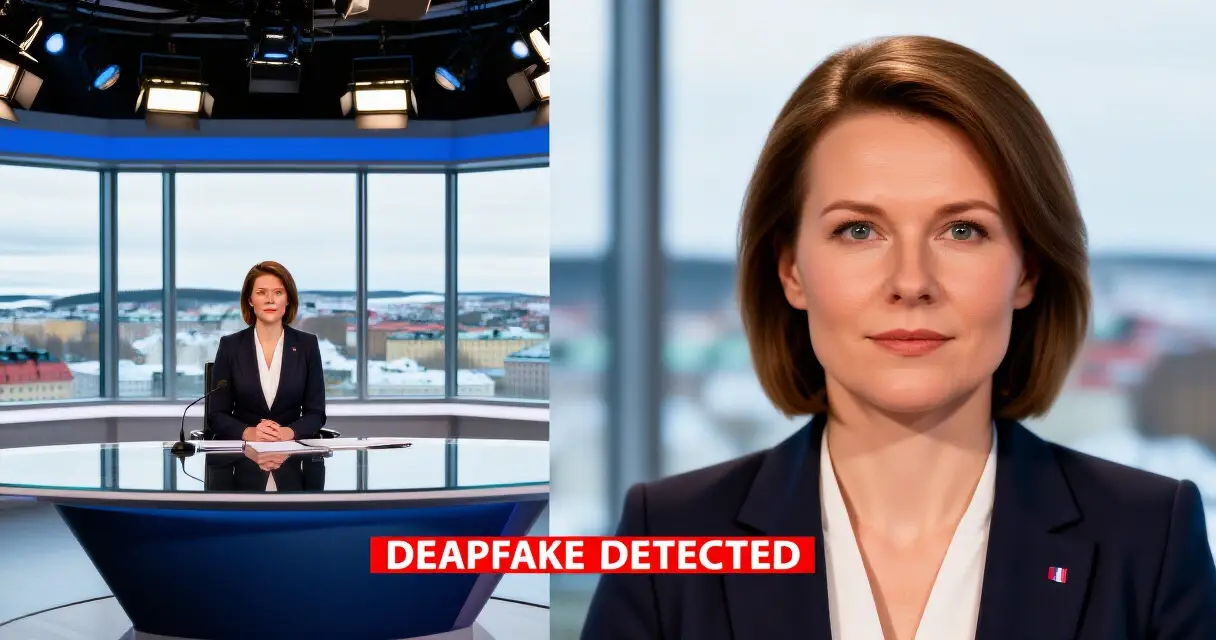
On September 5, 2026, Finland is grappling with a phenomenon that just a few years ago was largely the stuff of science fiction: a deepfake epidemic has landed in the Finnish media landscape, politics, and street-level fraud crimes. Synthetic media — images, audio, and video material produced or manipulated with AI technology — has become a concrete threat touching Finnish women, public figures, police officers, and ordinary citizens. Polymarket prediction markets are tracking EU AI regulation intensively, and the market signals that the next 12 months are decisive for how the consequences of deepfake technology are finalized in legislation. This article combines investigative journalism with analysis of Polymarket data and offers the reader an overall picture of where Finland currently stands — and where it is headed.
What Is Finland’s Deepfake Epidemic — and Why Does It Affect Everyone Now?
Finland’s deepfake epidemic refers to the explosive growth of AI-generated fake images, videos, and audio recordings, visible in fraud crimes, as a tool of sexual harassment, and in political manipulation. Yle reported in March 2026 that it found a website hosting nearly 1,500 fabricated explicit images of well-known Finnish women — including public figures and politicians. The case revealed how easily synthetic media can be weaponized against Finnish public figures. In September 2026, Yle revealed more: the cases included explicit deepfake images of women serving as volunteers in the Defence Forces, manipulated photographs of women’s colleagues, and the abuse of nude imagery targeting a group of underage girls.
At the same time, Finnish police warned in June 2026 of a new type of fraud in which criminals used Google Meet video calls and suspected AI-based deepfake technology to impersonate police officers. Particularly alarming was that the scams used the faces of known police officials — including National Police Commissioner Ilkka Koskimäki. The scams targeted people with immigrant backgrounds in particular, and according to police estimates, AI-assisted phone fraud caused 88 million euros in damages in Finland in 2025 alone. This figure is concrete evidence that the deepfake epidemic is not merely a media phenomenon but an economic security problem.
Polymarket Data: What Do Prediction Markets Say About AI Regulation and Deepfake Legislation?
Polymarket — the world’s largest decentralized prediction market platform — does not currently offer a single, Finland-specific deepfake contract. Instead, the markets track several questions related to EU AI regulation and synthetic media that have a direct impact on Finland. Polymarket data reflects the collective assessment of global investors and experts on how quickly and strictly AI regulation will advance in Europe.
Active trading is taking place on topics such as: whether the EU AI Act’s implementation proceeds on schedule, whether any major social media platform receives a significant EU sanction for AI content violations by the end of 2026, and whether deepfake charges in European courts reach historically unprecedented levels. The editorial team monitors these markets and updates forecasts regularly — probabilities shift as legislators act and cases progress through the courts.
Market signal vs. editorial interpretation: It is important to distinguish what prediction markets tell us (collective guesswork) from what they do not tell us (certainty). Polymarket trading reflects market participants’ expectations, not guaranteed outcomes. Contracts related to deepfake regulation have had liquidity constraints, meaning low trading volumes may reflect the views of a small expert pool rather than a broad market consensus.
The EU AI Act and Deepfakes: What Did August 2026 Change?
The EU AI Act’s high-risk obligations began to apply in August 2026, marking a turning point in the history of AI oversight. The legislation does not apply solely to AI models themselves but also to their application environments — and this means that platforms, apps, and services leveraging deepfake technology come under stricter scrutiny.
In Finland, the national AI oversight system entered into force on January 1, 2026, and Finland has chosen a decentralized model: different sectoral authorities supervise compliance with the AI Act in their own domains rather than having a single unified AI authority. Traficom acts as the national contact point for EU AI regulation. This structure may be a strength in terms of specialized expertise, but it can also lead to coordination gaps — particularly in cross-sectoral deepfake cases where the boundary between media, criminal law, and data protection is blurred.
The EU’s Digital Services Act (DSA) is in practice the most important instrument for implementing obligations to detect, label, and remove deepfake content. Under the DSA, large platforms are obliged to maintain effective systems for reporting and removing illegal content — and deepfake pornography is clearly illegal content in several EU countries, including Finland.
Finland’s National Legislation: First Conviction Already in January 2026
Finland has acted swiftly at the national level. Yle reported in March 2026 that Finland already has a law that prohibits the distribution of AI-generated nude imagery without consent. More significantly, the first conviction for distributing AI-generated nude imagery was handed down in Finland in January 2026 — just weeks after the national AI oversight system entered into force.
This is a significant signal: Finland is not merely writing laws on paper — prosecutors and courts have already applied them in practice. The early conviction carries both symbolic weight as a precedent and a practical deterrent effect. It also signals to investors and international actors that Finland takes the misuse of synthetic media seriously — which influences how Polymarket-style markets price the progress of regulation in the Nordic region.
Nordic Comparison: Denmark Leading Legislative Development
Among the Nordic countries, Denmark is currently the most advanced in developing deepfake legislation. Denmark’s proposed legislative amendment would protect people’s physical characteristics and performers’ digital likenesses under copyright law, with the proposed protection period extending 50 years after death. Denmark channels enforcement through the DSA framework, making it consistent with an EU-wide approach.
Sweden and Norway have not published comparable national deepfake legislative packages on the same timeline, although political discussions on the topic are underway in both countries. Iceland’s situation has not yet crystallized into legislative proposals. This means the Nordic countries are advancing at different paces — which can create both competitive advantages (Finland and Denmark attracting AI responsibility pioneers) and regulatory arbitrage opportunities (actors moving to countries with looser regulation).
| Country | Legislative Status (September 2026) | Key Mechanism | Convictions? |
|---|---|---|---|
| Finland | Law banning distribution of AI-generated nude imagery in force; national AI oversight began 1 Jan 2026 | Criminal law + DSA + AI Act decentralized oversight (Traficom as contact point) | Yes — first conviction in January 2026 |
| Denmark | Copyright law amendment proposed: protects physical characteristics for 50 yrs after death | Copyright law + DSA | No confirmed information |
| Sweden | Political discussion ongoing, no national deepfake law yet | General criminal law, DSA | No confirmed information |
| Norway | Legislative preparation underway, no confirmed legislative package | DSA, general data protection | No confirmed information |
| EU level | AI Act high-risk obligations began August 2026; DSA in enforcement | AI Act + DSA combination | Proceedings underway |
A Police Officer’s Face in a Scam Video: How Deepfake Fraud Works in Finland
Finns’ experience of deepfake fraud has become increasingly concrete since June 2026. In the fraud scheme reported by police, criminals called victims via Google Meet video calls using AI technology to impersonate police officers. The scams particularly targeted people with immigrant backgrounds, who have less knowledge of Finnish police procedures — and thus a lower threshold for believing a figure of authority presented in video form.
A particular feature of the case was that the deepfake images used by the criminals included the face of National Police Commissioner Ilkka Koskimäki. This means deepfake technology is now so advanced and accessible that it can convincingly imitate a named, public official — someone whose credibility is based precisely on recognizability. When that credibility can be stolen with AI, the entire concept of an authority figure in media and official communications is called into question.
Beyond the police warnings, the case revealed a knowledge gap in Finnish media literacy. How many ordinary citizens know how to identify a deepfake video call? How do Finns with immigrant backgrounds receive information about such threats in their native languages? These are questions that both the media and public authorities must answer systematically.
Finnish Women as Targets: 1,500 Fabricated Images and a Broader Phenomenon
Yle’s March 2026 investigation — finding a website with nearly 1,500 AI-generated explicit images of well-known Finnish women — reveals another, equally serious dimension of the deepfake epidemic. Those victimized include public figures, politicians, and other citizens who did not consent to the creation of such material.
In September 2026, Yle reported on a broader set of cases that included:
- Explicit deepfake images of women serving as volunteers in the Defence Forces
- Manipulated photographs of women’s colleagues, distributed within their social circles
- Abuse of nude imagery involving an underage boy and dozens of girls in a sexual exploitation context
These cases show that deepfake technology is not solely a “celebrity problem” — it has entered everyday social environments: workplaces, educational institutions, the Defence Forces, and schools. Legislation has already responded — Finland’s new law prohibits the distribution of such material — but the technical means to create it are now more readily available than the means to detect or prevent it.
The AI Data Center in Mikkeli and the Infrastructure Paradox
While Finland struggles with the consequences of the deepfake epidemic, infrastructure is being deliberately built to support the advancement of AI. A precise example: on September 2, 2026 — just three days before this article’s publication — a 165-megawatt AI data center opened in Mikkeli. The facility is part of a broader Nordic infrastructure push attracting global technology companies to the region for its affordable electricity, cool climate, and robust data infrastructure.
The paradox is clear: the same infrastructure that enables beneficial AI applications — medicine, climate research, education — also enables the running of increasingly powerful deepfake models. The democratization of computing power means that producing sophisticated synthetic media no longer requires owning a supercomputer — only a cloud connection. The data center opened in Mikkeli is therefore both a promise of Finnish technological competitiveness and a reminder that infrastructure investments also carry the risks of AI misuse.
The Finnish government has also reacted to the changing environment: it has cancelled plans to grant new public funding for data centers, reflecting a shifting attitude toward public support for AI infrastructure. This is a signal that Polymarket investors are watching closely: is Finland changing course on infrastructure policy, and if so, how will it affect the competitiveness of the Nordic AI ecosystem?
Media and the Trust Crisis: How Yle and Other Finnish Media Are Responding
Yle has taken a clear investigative role in Finland’s deepfake coverage. It has published significant investigations into both explicit deepfake images of public figures and AI-based scam video calls. This role is important: public broadcasting serves as a trusted source of information at a time when the credibility of media itself is under attack.
The threat of synthetic media targets not only private individuals but also the functioning of the press as a whole. If a citizen cannot trust video or audio, they may also question genuine news footage — this is the so-called liar’s dividend phenomenon. Deepfake technology facilitates not only fabrication but also the denial of genuine material: a politician or criminal can claim that evidence is AI-generated, even when it is authentic.
There is currently no publicly available information from Finnish media reports on how Sanoma or Alma Media have responded to the deepfake threat at an organizational level. This gap is itself telling: media companies with a great deal at stake in terms of authenticity have not — at least publicly — positioned themselves as industry leaders in developing deepfake protection.
What Media Outlets Should Do — Practical Recommendations for Editorial Leadership
- Invest in digital media authentication: The C2PA (Coalition for Content Provenance and Authenticity) standard enables cryptographic provenance marking of news material. Finnish media companies should consider adopting it.
- Train staff in deepfake detection: Journalists must have practical skills for identifying AI-generated material — this is now a core professional requirement.
- Build shared verification protocols: Nordic cooperation — for example between Yle, SVT, and DR — could develop common standards for verifying video authenticity.
- Communicate transparently with audiences: Media outlets must clearly explain how they verify the authenticity of material — especially in sensitive political or security-related situations.
- Participate in the legislative process: Media companies are key stakeholders in the implementation of the DSA and AI Act. Active participation in legislative work is both an industry interest and a social responsibility.
The Development of Deepfake Technology 2025–2026: What Is Possible Now?
To understand the scale of the threat, it is important to grasp where the technology currently stands. In 2025–2026, the quality of deepfake models has improved dramatically: face swapping, voice cloning, and video synthesis have all reached a level where ordinary viewers can no longer distinguish authentic material from AI-generated content without specialized software.
Key technological developments include:
- Real-time face swapping: Video deepfakes have moved from post-processing to real-time — face swapping during video calls is possible on an ordinary consumer computer
- Voice cloning from seconds of audio: Several commercial platforms create convincing voice copies from fewer than five seconds of audio material
- Multimodal models: The latest models produce combined video, audio, and text content with unified AI logic, making fabrications increasingly convincing
- Democratization of access: Many advanced deepfake tools are open source or available as affordable SaaS services
On the other hand, detection and identification technology is also advancing. Researchers have developed methods that examine blink rate, skin texture, lighting consistency, and digital metadata as signs of inauthenticity. The increase in computing power brought by data centers like Mikkeli’s could in future also support the development of detection software — but the race between attackers and defenders is ongoing.
Commercial and Economic Impact: 88 Million Euros Is Just the Tip of the Iceberg
The 88 million euros in fraud losses in 2025 reported by police is a significant figure — but it captures only the direct financial damage that made it into crime statistics. The true economic impact of the deepfake epidemic is broader and harder to measure.
Not counted are, among other things:
- Reputational damage: Public figures, politicians, and corporate executives whose images have been used in deepfake material suffer reputational harm that affects their professional standing and organizations’ trust capital
- Litigation costs: Criminal proceedings in deepfake cases generate costs for both victims and taxpayers
- Media industry verification costs: Media outlets must invest ever more in verifying the authenticity of material
- New risks for the insurance sector: Deepfake fraud significantly changes insurance companies’ risk models
- Political campaign costs: Countering deepfakes becomes part of political campaign budgets
In international comparison, Finland’s 88 million euro fraud statistic appears significant relative to the country’s size. As a preliminary estimate, this would amount to approximately 16 euros per Finnish person per year in direct fraud losses alone — a figure not to be underestimated.
| Impact Category | Manifestation Observed in Finland | Method of Assessment |
|---|---|---|
| Direct fraud losses | €88M in 2025 (source: Finnish police, Yle) | Police-reported, unverified aggregate figure |
| Non-consensually distributed sexual imagery | ~1,500 images (source: Yle, March 2026) | Number found by Yle on research website |
| Legal and court processing costs | No public data | Not estimated in this article |
| Reputational damage to public figures | Politicians and celebrities among victims | Qualitative, not quantified |
| Infrastructure investment (AI data centers) | 165 MW, Mikkeli (2 Sep 2026) | Public announcement |
Finland’s Government AI Foreign and Security Policy: Expert Group Established
The Finnish government has decided to establish an expert group to examine the foreign and security policy implications of AI. This is a significant signal: deepfakes are no longer solely a matter for the criminal police or consumer protection — they have risen to the heart of national security policy discussion.
The expert group’s mandate has a direct connection to the deepfake phenomenon: when AI can imitate the top leadership of police, manipulate images depicting politicians, and produce information influence material, it is a foreign and security policy issue. Russian information influence targeting Finland is a known, documented threat — and deepfake technology is its most powerful new tool.
To understand Finland’s situation, it is important to note that Finland joined NATO in 2023 — and this change has also altered its information environment risk profile. Deepfake technology as an instrument of hybrid influence is therefore more topical in Finland than in many other EU countries.
Practical Advice: How Can a Finn Identify Deepfake Material?
The deepfake epidemic is real, but that does not mean every video or image is fabricated. Critical media literacy is the most effective first line of defence. Below are concrete tips to help Finns assess the authenticity of a video or image:
- Check the source: Does the video come from a trusted news outlet or an unknown account? Source credibility remains the single most important factor.
- Pay attention to unnatural details: Blink rates, lip synchronization with speech, lighting inconsistencies, and hair edges are common deepfake weaknesses — though newer models have improved in these areas too.
- Use verification tools: Several free websites and browser extensions offer deepfake detection analysis — their accuracy varies, but they are a useful addition to the analysis.
- Question unusual context: If you hear or see a public figure saying something that seems completely out of character, question it before sharing.
- Cross-check multiple sources: If a claim or video appears in only one place and cannot be verified elsewhere, treat it with heightened scepticism.