Summary
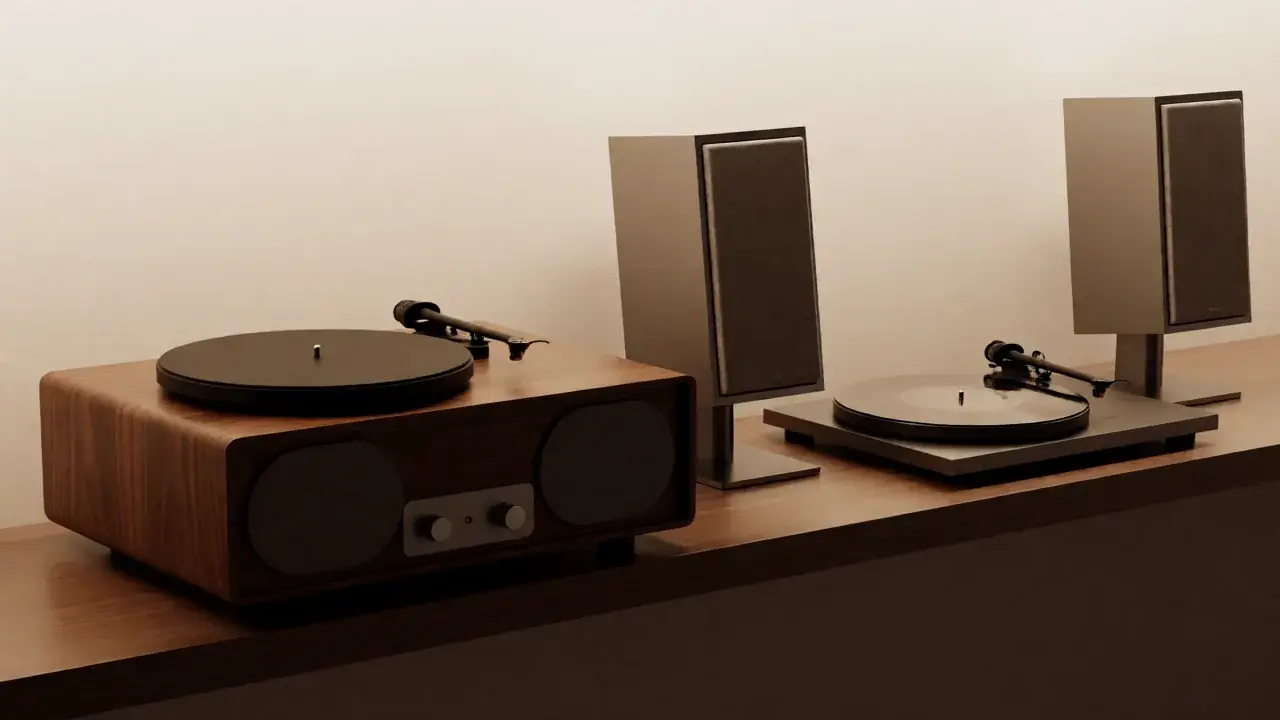
The best record player with speakers means two very different things, and the difference decides how much you spend and how good it sounds. Some players have speakers built into the case. Others are a proper turntable paired with separate...
Table of Contents
- 1 The short answer
- 2 All-in-one or separates?
- 3 The best record player with speakers built in
- 3.1 Angels Horn H019 — around $240
- 3.2 Victrola Eastwood II — around $130
- 3.3 What to skip
- 4 Best turntable and speaker pairings
- 4.1 AT-LP60X + Edifier R1280DB — the sensible starting point
- 4.2 Fluance RT81 + Kanto YU4 — worth saving for
- 5 What about Bluetooth?
- 6 Common questions
- 6.1 Do I need an amplifier?
- 6.2 What is a phono preamp and do I need one?
- 6.3 Can I use my existing Bluetooth speaker?
- 6.4 How far apart should the speakers be?
- 7 Where to start
The best record player with speakers means two very different things, and the difference decides how much you spend and how good it sounds. Some players have speakers built into the case. Others are a proper turntable paired with separate speakers. Both are valid. Buying the wrong one for your situation is the expensive mistake.
This guide covers both routes, what each costs, and which specific setups are worth buying in 2026.
The short answer
- Best all-in-one: Angels Horn H019 — one box, genuinely listenable speakers, around $240.
- Best separates under $300: Audio-Technica AT-LP60X plus Edifier R1280DB — about $370 together and a clear step up in sound.
- Best with Bluetooth: Audio-Technica AT-LP60XBT — wireless to a speaker you already own, wired when you want quality.
- Best sounding overall: Fluance RT81 plus Kanto YU4 — around $600, and the point where vinyl starts to justify itself.
All-in-one or separates?
This is the only decision that really matters. Everything else follows from it.
| All-in-one | Separates | |
|---|---|---|
| Typical cost | $130–$250 | $370–$700 |
| Setup | Plug in, play | Three cables, ten minutes |
| Sound quality | Adequate to good | Good to excellent |
| Space needed | One shelf | Shelf plus two speakers |
| Upgrade path | None — replace the whole unit | Swap either part independently |
| Vibration risk | Speakers shake the platter | Isolated |
The vibration point deserves explaining, because it is the real engineering problem with all-in-ones. Speakers move air by physically vibrating. When they sit in the same case as the platter, that vibration reaches the stylus, which is trying to read movements measured in microns. At low volume it does not matter. Turn it up and you get muddiness, and at the extreme, skipping.
Good all-in-ones mitigate this with better isolation and by aiming the speakers away from the platter. Cheap ones do not try.
The best record player with speakers built in
Angels Horn H019 — around $240
The one all-in-one worth recommending without caveats. It uses a belt drive, a replaceable Audio-Technica cartridge, and speakers that sound like speakers rather than a phone on loud. The wooden plinth helps damp vibration in a way plastic cases do not. Our all-in-one guide sets out the four specifications to check on any unit in this category.
It also has line-out, which matters more than it sounds: when you outgrow the built-in speakers, you can connect external ones and keep the turntable. Most all-in-ones lock you in.
Victrola Eastwood II — around $130
Victrola’s reputation was built on cheap suitcase players, and it has spent recent years trying to escape it. The Eastwood II is the result: a proper Audio-Technica cartridge, adjustable counterweight, and Bluetooth in both directions.
It is not as good as the Angels Horn, but it is over $100 cheaper and considerably better than the brand’s entry-level range. If the budget is firm, this is the floor worth buying at.
What to skip
Suitcase players under $100 — the ones in bright colours with a carry handle. They track far too heavily, the stylus cannot be replaced, and the speakers face directly into the record. They will play music. They will also gradually wear the records you play on them.
Best turntable and speaker pairings
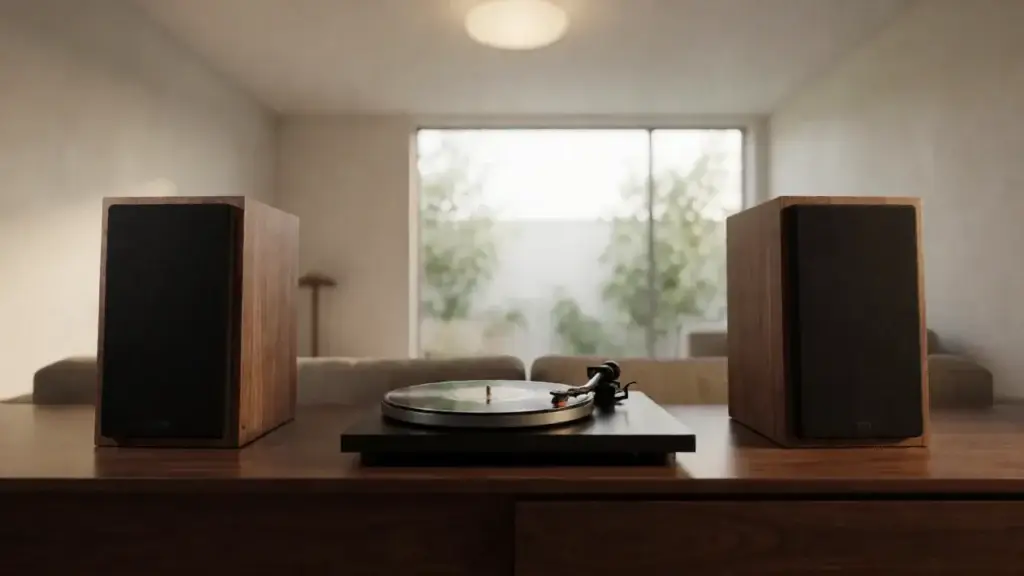
If you have room for two speakers, this is where the money goes further. All three pairings below use powered speakers, which have the amplifier built in — no separate receiver needed. Our active speakers guide covers those models in their own right, and the packages guide costs out four complete systems.
| Turntable | Speakers | Total | Best for |
|---|---|---|---|
| Audio-Technica AT-LP60X | Edifier R1280DB | ~$370 | First proper setup |
| Fluance RT81 | Kanto YU4 | ~$600 | Serious listening |
| U-Turn Orbit Basic | Audioengine A2+ | ~$500 | Small rooms, desk setups |
AT-LP60X + Edifier R1280DB — the sensible starting point
Around $370 for the pair, and it is the setup most people should buy. The turntable is fully automatic, so there is no needle-dropping to get wrong. The Edifiers have a built-in phono stage, which means the turntable connects straight to them with no extra box.
Compared to a $240 all-in-one, the difference is not subtle. Bass extends lower, and separating the speakers by a metre or two produces an actual stereo image instead of sound coming from one point.
Fluance RT81 + Kanto YU4 — worth saving for
Around $600. The RT81 has an adjustable counterweight and anti-skate, so you can set tracking force properly — see our setup guide — and a solid wood plinth. The Kanto YU4s have real bass and enough power for a living room.
This is the level where people who described vinyl as “warm” start to sound less like they are imagining it. Below this you are hearing records. Here you start hearing what was recorded.
What about Bluetooth?
Bluetooth turntables send audio wirelessly to a speaker you already own. It is genuinely convenient and it does compress the signal.
There is a reasonable objection: buying an analogue format and then digitising it for transmission slightly defeats the point. That is true in principle. In practice, if Bluetooth is the difference between playing records weekly and leaving the turntable unused, take the convenience.
The AT-LP60XBT is the model to get. It does Bluetooth when you want it and wired output when you care, so nothing is permanently traded away.
Common questions
Do I need an amplifier?
Not with powered speakers — the amplifier is inside them. You only need a separate amp for passive speakers, which is a route worth taking later, not first.
What is a phono preamp and do I need one?
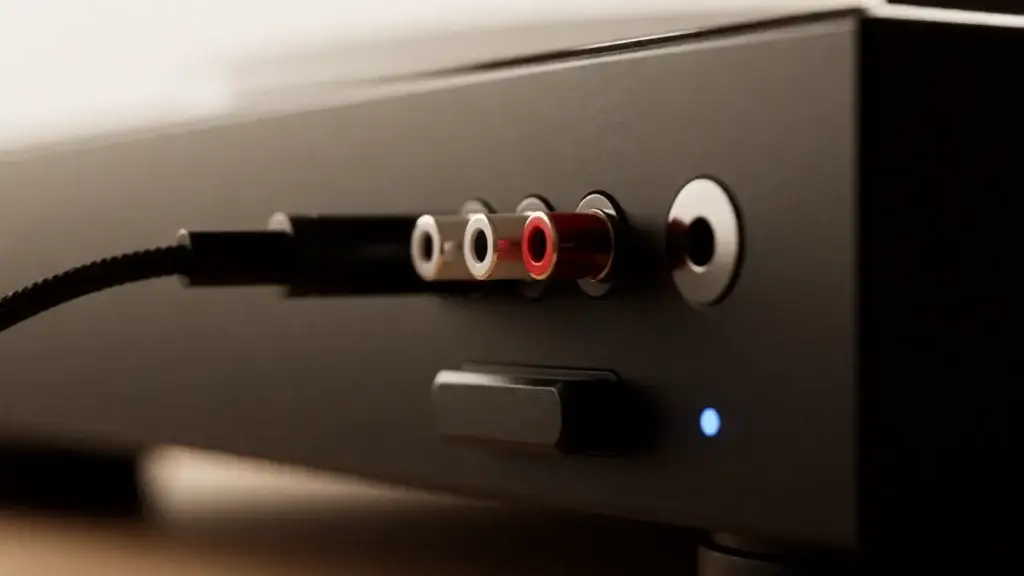
A turntable’s signal is far quieter than a phone or laptop’s, and needs a phono preamp to bring it up to line level. Most beginner turntables have one built in, and speakers like the Edifier R1280DB do too. You need to buy one separately only if neither does — check both before ordering.
Can I use my existing Bluetooth speaker?
Yes, with a Bluetooth-equipped turntable. It will not sound as good as dedicated stereo speakers — a single portable speaker cannot produce a stereo image — but it works, and it costs nothing extra to try.
How far apart should the speakers be?
Roughly 1–2 metres, angled slightly toward where you sit, ideally at ear height. Speakers on a shelf below knee level lose most of their detail. This costs nothing and improves the sound more than a $100 upgrade would.
Prices checked 27 July 2026 and shown in USD. They move often — treat them as a guide, not a quote.
Where to start
Short on space or want it simple: the Angels Horn H019, and you are done.
Room for two speakers: the AT-LP60X and Edifier R1280DB pairing at around $370. It costs slightly more than a good all-in-one, sounds considerably better, and lets you upgrade either half later instead of replacing everything.
If you are choosing your first turntable more generally, our guide to the best turntables for beginners covers the models in more detail, and the under $500 roundup covers what the next price bracket adds.