Summary
The best budget floor standing speakers exist in an awkward place. They are physically large, which means they can move air a bookshelf speaker cannot. They are also built to a price, which usually shows in the cabinet. Whether that...
Table of Contents
- 1 The short answer
- 2 Floorstanding versus bookshelf
- 3 The best budget floor standing speakers to buy
- 3.1 Wharfedale Diamond 12.3 — the value pick
- 3.2 Klipsch R-605FA — if your amplifier is weak
- 4 Setting them up
- 5 Common questions
- 5.1 Do floorstanders need a subwoofer?
- 5.2 Is a bigger speaker always better?
- 5.3 How much amplifier power do they need?
- 6 Where to start
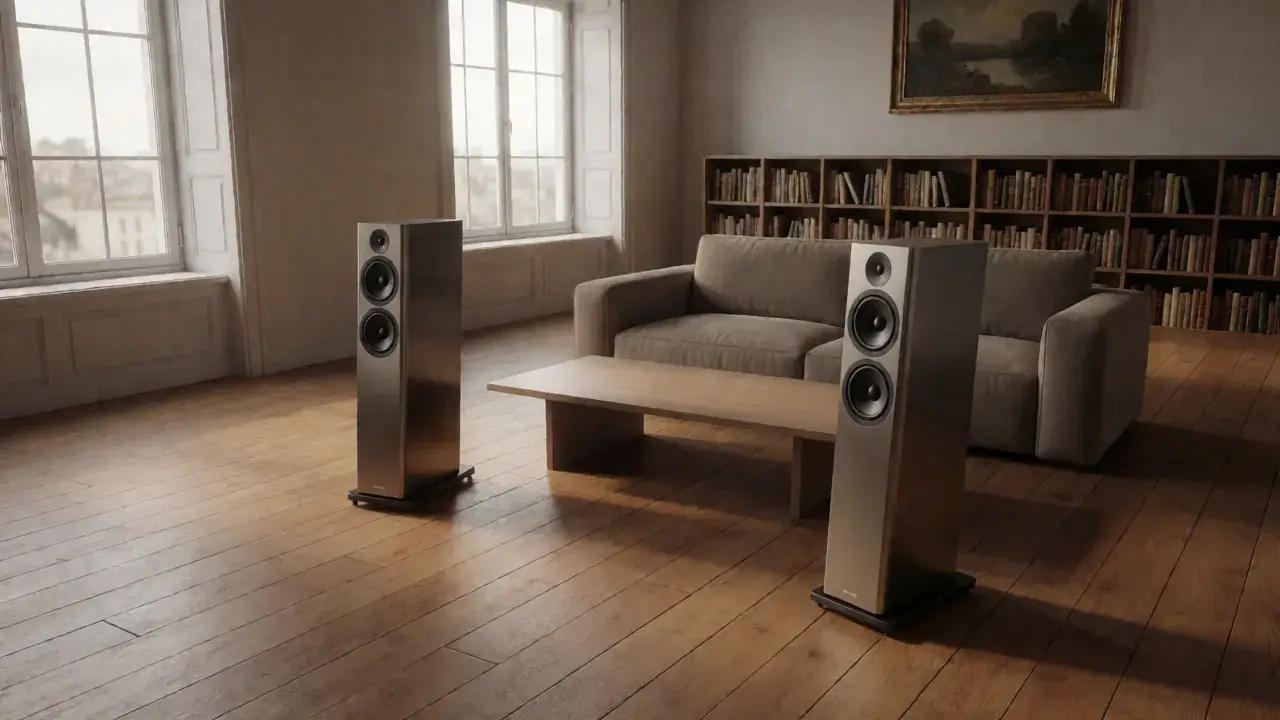
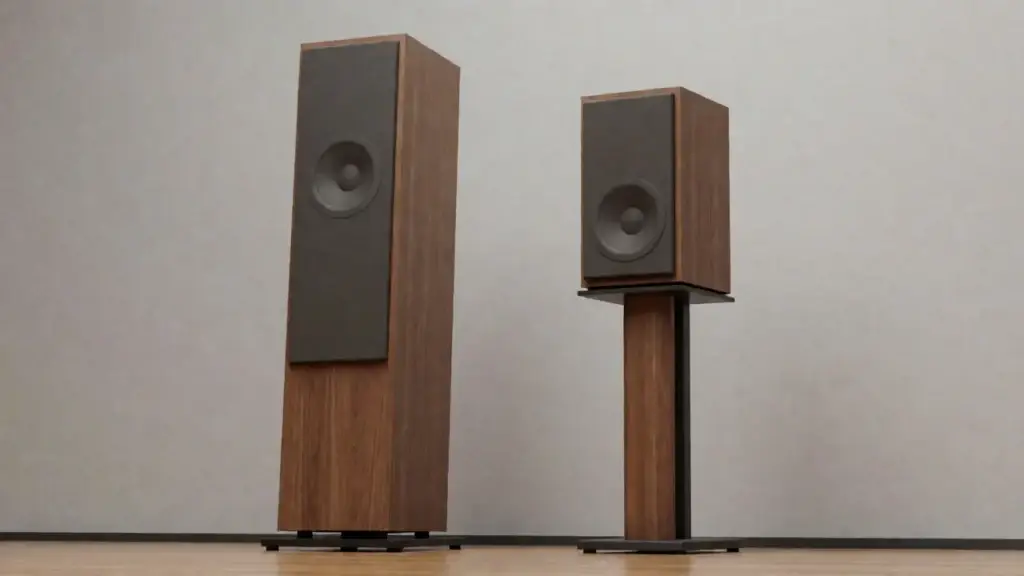
The best budget floor standing speakers exist in an awkward place. They are physically large, which means they can move air a bookshelf speaker cannot. They are also built to a price, which usually shows in the cabinet. Whether that trade is worth it depends almost entirely on your room.
This guide covers when a budget floorstander beats a bookshelf pair, when it does not, and which models are worth the money.
The short answer
- Buy floorstanders if: your room is over about 20 square metres and you have space to keep them away from walls.
- Buy bookshelf speakers if: the room is small, or the speakers must sit close to a wall. A good bookshelf pair beats a compromised floorstander easily.
- Best value: Wharfedale Diamond 12.3 — around $500 a pair and consistently well reviewed.
- Watch for: very slim cabinets at low prices. Narrow means less internal volume, which means less bass than the height suggests.
Floorstanding versus bookshelf
| Floorstanding | Bookshelf | |
|---|---|---|
| Bass extension | Deeper, usually 40–50Hz | Typically 55–70Hz |
| Room needed | 20 m² and up | Any |
| Wall proximity | Needs 30cm+ | More tolerant |
| Stands required | No | Yes, add $100 |
| Quality per dollar | Lower — cabinet costs more | Higher |
That last row is the one that decides most purchases. A floorstander needs three times the cabinet material, and at a fixed price that money comes out of the drivers and crossover. A $500 bookshelf pair typically has better components than a $500 floorstanding pair.
What you buy instead is air displacement, which no bookshelf speaker can match. In a large room, that wins. In a small one, it becomes a problem — a floorstander in a 12m² room produces bass the room cannot absorb. Our guide to speakers for bass and sound quality covers why placement changes this more than the speaker does.
The best budget floor standing speakers to buy
| Model | Approx. price/pair | Drivers | Best for |
|---|---|---|---|
| Wharfedale Diamond 12.3 | $500 | Dual 5″ | Best all-round value |
| Q Acoustics 3050i | $949 | Dual 5.25″ | Refinement over impact |
| Polk Reserve R500 | $664 | Dual 5.25″ | Films and music equally |
| Klipsch R-605FA | $650 | Dual 5.25″ | Efficient, works with low power |
Wharfedale Diamond 12.3 — the value pick
Around $500 a pair. Wharfedale has been building speakers since 1932 and the Diamond line has been the budget reference for most of three decades. The 12.3 continues it: two 5-inch woofers, a well-braced cabinet, and a tuning that errs toward warmth rather than excitement.
They are forgiving of a modest amplifier, which matters at this price — a speaker that demands expensive amplification is not really a budget speaker.
Klipsch R-605FA — if your amplifier is weak
Klipsch build unusually sensitive speakers, meaning they play louder on less power. If you are driving them from a modest receiver, this matters more than any other specification here.
The horn-loaded tweeter is divisive — some hear detail, others hear harshness. Worth listening before buying if you can.
Setting them up
- At least 30cm from the back wall. Rear-ported floorstanders pushed against a wall boom badly. Some ship with foam plugs for exactly this situation.
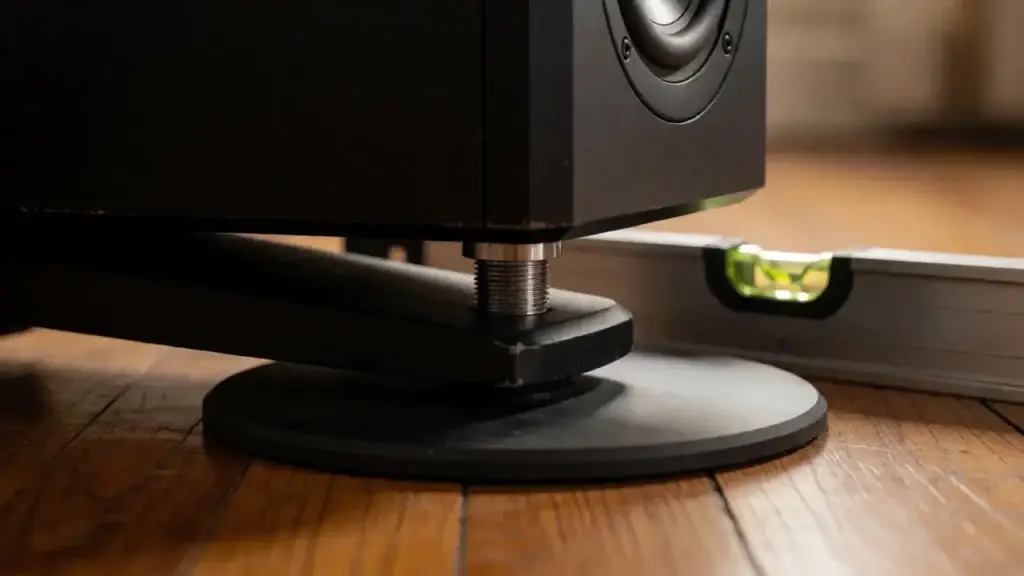
- Use the spikes. They couple the cabinet to the floor and stop it rocking. On a hard floor, use the supplied discs so you do not gouge it.
- Angle them inward slightly. Aim at a point just behind your head rather than straight down the room.
- Keep them apart. Roughly 2 metres for a normal listening distance. Closer than 1.5m and the stereo image collapses toward the middle.
Common questions
Do floorstanders need a subwoofer?
For music, rarely — reaching 40–45Hz covers almost everything. For films, a subwoofer still helps, because the effects channel goes lower than any floorstander at this price.
Is a bigger speaker always better?
No, and this is where people waste money. A large speaker in a small room excites room modes badly, producing uneven, boomy bass that a smaller speaker would have avoided. Match the speaker to the room, not to the budget.
How much amplifier power do they need?
Check sensitivity rather than the power rating. A speaker rated 88dB or higher works well with 30–50 watts. Below 85dB you want considerably more power, which pushes the real cost of ownership up.
Prices checked 27 July 2026 and shown in USD. Street prices move often — treat them as a guide, not a quote.
Where to start
Measure the room before choosing. Under about 20m², buy a good bookshelf pair and stands instead — you will get better components for the money and better bass behaviour. Above that, the Wharfedale Diamond 12.3 at around $500 is the sensible starting point.
Building a whole system? Our home stereo guide covers how to split a budget between speakers and amplification, and our active speakers guide covers the powered route that needs no amplifier at all.