Summary
✓Reviewed by David ChenA Dolby Atmos soundbar is the fastest way to get height-channel, object-based surround sound into a living room in 2026 without running speaker wire through the walls. The best current models pair a single bar with a...
Table of Contents
- 1 How We Know: Sourcing and Method
- 2 What “Dolby Atmos Soundbar” Actually Means
- 3 2026 Soundbar Market Snapshot: Where the Category Stands
- 4 Soundbar Configurations Compared: 2.1 vs. 3.1 vs. 5.1 vs. 7.1.4
- 4.1 Why the Center Channel Matters More Than Height Drivers for Most Buyers
- 5 Wireless Subwoofers: What Actually Differs Between Tiers
- 6 Reference-Tier and Premium Home Theater Speaker Pricing
- 7 Soundbar vs. Full Surround System vs. Bookshelf-Based Setup
- 8 Where Soundbars Intersect With a Turntable-Based Listening Room
- 9 Specification Checklist: What to Actually Look For
- 10 Room Size and Placement: The Variable Every Spec Sheet Ignores
- 11 Budget Tiers: What Your Money Buys at Each Price Point
- 12 Limitations of This Guide
- 13 The Bottom Line for 2026 Buyers
- 13.1 Related Reading
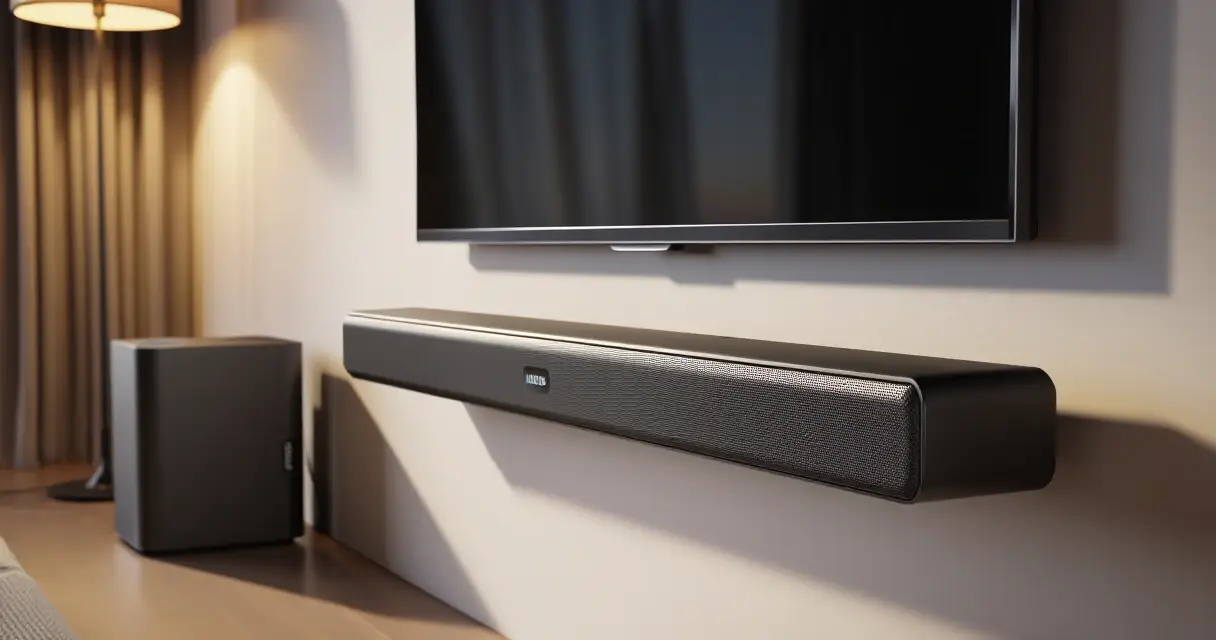
A Dolby Atmos soundbar is the fastest way to get height-channel, object-based surround sound into a living room in 2026 without running speaker wire through the walls. The best current models pair a single bar with a wireless subwoofer and, in higher-tier bundles, wireless rear satellites, and they range from roughly $230 to well over $1,000 depending on channel count and how many upward-firing or dedicated height drivers are built in. This guide breaks down what “Atmos-capable” actually means on a spec sheet, which configurations are worth the premium, and where the money really goes between a $280 average-priced bar and a $1,298 reference system.
Soundbars have quietly become the default home theater upgrade in the United States. According to market research firm IndexBox, Dolby Atmos-capable models now account for an estimated 30% to 40% of U.S. soundbar revenue, and the category as a whole is projected at $3.5 billion to $5.0 billion in annual U.S. retail revenue in 2026, with unit volume estimated between 15 million and 20 million units sold this year alone. That is a lot of boxes going into a lot of living rooms — and a lot of buyers who are choosing between a $230 bar-and-sub 2.1 setup and a $1,000-plus 5.1 or 7.1.4 bundle without a clear sense of what the extra channels, drivers, and wireless subwoofer actually buy them.
This is not a hands-on lab test — we did not measure frequency response or run calibrated listening sessions for this piece. What follows is a spec-led breakdown built from manufacturer documentation, published market research, and current retailer pricing as of September 24, 2026, with every figure attributed to its source so you can verify it yourself before buying.
How We Know: Sourcing and Method
The market figures and category trends in this guide come from published 2026 industry research — IndexBox’s United States soundbar and home-theater-soundbar market reports, Global Market Insights’ North America soundbars market forecast, Morgan Reed Insights’ North America soundbars market report, ResearchAndMarkets’ soundbars market report, and SourceReady’s U.S. audio devices market report. Pricing references are drawn from current 2026 buying-guide coverage, including Wirecutter’s soundbar reviews, What Hi-Fi’s surround sound and speaker buying guides, and HomeTheaterHiFi.com’s 2026 recommended gear list. Where a figure is a market estimate rather than a hard count, that is noted explicitly. We do not claim to have tested any specific soundbar model in a controlled listening room for this article; treat channel counts and driver specs as manufacturer-published data unless otherwise noted.
What “Dolby Atmos Soundbar” Actually Means
Dolby Atmos is an object-based surround format: instead of mixing audio into fixed channels (left, right, center, surrounds), a mix engineer places individual sound objects in three-dimensional space, including overhead. A true Atmos-capable soundbar needs either physical upward-firing drivers that bounce sound off the ceiling to simulate height, or Dolby’s own virtualization processing that approximates height cues without a dedicated driver. The difference between those two approaches is one of the biggest hidden variables in soundbar shopping, and it is rarely explained clearly on a retail product page.
A soundbar’s channel notation — 2.1, 3.1, 5.1, 7.1.2, 7.1.4 — tells you what it actually has under the hood. The first number is forward-firing or surround channels, the number after the first decimal is subwoofer count, and the final number (when present) is dedicated upward-firing or height driver count. A 5.1.2 system has five main channels, one sub, and two height drivers; a 7.1.4 has seven main channels, one sub, and four height drivers. More height drivers generally means more precise overhead imaging, but only if the room has a flat, reasonably low ceiling for the sound to reflect off.
2026 Soundbar Market Snapshot: Where the Category Stands
The soundbar category has grown steadily as a simpler alternative to full surround-speaker installs, and 2026 market data shows that growth continuing on multiple fronts at once — revenue, average selling price, and channel-count mix are all shifting.
| Metric | 2026 Figure | Source |
|---|---|---|
| U.S. soundbar market revenue (2026 est.) | $3.5B–$5.0B annually | IndexBox |
| U.S. soundbar unit volume (2026 est.) | 15M–20M units | IndexBox |
| Average soundbar selling price (2026) | $230–$280 (up from $180–$220 in 2020) | IndexBox |
| Dolby Atmos share of U.S. soundbar revenue | 30%–40% | IndexBox |
| 3.1-channel segment share | 15%–20% of units, 18%–25% of revenue | IndexBox |
| 2.1-channel segment share (2025) | 40%–45% of unit sales, shrinking | IndexBox |
| Premium soundbars over $300 (Atmos/DTS:X, multi-channel) revenue share | 35%–40% | IndexBox |
| North America soundbars market size (2026) | $2.48B, 6.4% CAGR to 2035 | Global Market Insights |
| North America soundbars market size (2026, alt. estimate) | $3.8B, growing to $6.81B by 2035 | Morgan Reed Insights |
| Global soundbars market (2026) | $8.13B, up from $7.5B in 2025 (8.4% CAGR) | ResearchAndMarkets |
| U.S. soundbar import dependence | >80% of units from China, Vietnam, Malaysia | IndexBox |
The most useful number in that table for a shopper isn’t the market size — it’s the shift away from bare 2.1 systems. IndexBox’s 2025 data put 2.1-channel bar-and-sub combos at 40% to 45% of unit sales, the largest single segment, but that share is described as actively shrinking as 3.1-channel and 5.1-channel configurations gain traction. In plain terms: the market is moving toward center-channel dialogue clarity (the “+1” in 3.1) and away from stereo-only bars, even at the entry-level price points.
The import-dependence figure matters for anyone timing a purchase around a sale. With more than 80% of U.S. soundbar units sourced from manufacturing hubs in China, Vietnam, and Malaysia according to IndexBox, pricing on this category is more exposed to shipping costs and trade policy shifts than, say, a turntable built primarily from a smaller number of higher-value components. If you’ve been tracking our amplifier buying guide or other hi-fi gear for price swings, the same logistics sensitivity applies here, arguably more so given the sheer unit volume moving through the category.
Soundbar Configurations Compared: 2.1 vs. 3.1 vs. 5.1 vs. 7.1.4
Channel count is the single biggest driver of both price and real-world performance difference between soundbars. Here’s how the major configurations stack up on what they include and what kind of room and budget they suit.
| Configuration | What’s Included | Typical Use Case | Approx. Market Position |
|---|---|---|---|
| 2.1 | Bar (L/R channels) + wireless subwoofer | Small rooms, apartments, TV dialogue boost on a tight budget | Largest unit segment (40%–45% in 2025), shrinking |
| 3.1 | Bar with dedicated center channel + wireless subwoofer | Dialogue-heavy viewing, small-to-medium living rooms | 15%–20% of units, 18%–25% of revenue, gaining share |
| 5.1 | Bar + sub + two wireless surround satellite speakers | Medium rooms wanting real rear-channel surround, not just virtualized | Growing segment per IndexBox |
| 7.1.2 / 7.1.4 | Bar + sub + rear satellites + 2 or 4 height/upward-firing drivers | Dedicated home theater rooms, Atmos-mixed movies and shows | Premium tier, over $300, ~35%–40% of category revenue |
A practical rule from current 2026 buying-guide coverage on speaker selection generally: small rooms or desks are best served by bookshelf or compact powered speakers, while medium-to-large rooms benefit from a bookshelf-plus-subwoofer pairing or floorstanding speakers. The same room-size logic carries over almost exactly to soundbars — a 2.1 in a small apartment living room can sound perfectly full, while the same bar in a 20-foot room will leave the center and sides feeling hollow, which is exactly the gap that 3.1 and 5.1 configurations are built to close.
Why the Center Channel Matters More Than Height Drivers for Most Buyers
If your primary frustration with TV audio is muddy or quiet dialogue rather than a lack of overhead movie-theater effects, a 3.1 system’s dedicated center channel will usually deliver more noticeable everyday improvement than a 5.1.2 or 7.1.4’s height drivers. Height channels are mixed sparingly even in Atmos-native content — rain, footsteps, a helicopter passing overhead — while center-channel dialogue is present in nearly every scene of nearly everything you watch. This is worth weighing seriously against the sticker price jump from a $230–$280 average-priced 2.1/3.1 bar into premium $300-plus territory.
Wireless Subwoofers: What Actually Differs Between Tiers
Nearly every soundbar sold today, from entry-level 2.1 bars to $1,000-plus Atmos systems, ships with a wireless subwoofer rather than a wired one, which has simplified installation dramatically compared to a decade ago. What differs between price tiers is driver size, enclosure design (ported vs. sealed), and amplifier power, none of which are consistently disclosed on retail listings in a way that makes direct comparison easy.
Wirecutter’s 2026 soundbar testing notes that some soundbar-included subwoofers are competitive with standalone subs in their measured performance — a meaningful claim, since it implies the wireless sub bundled with a good mid-tier bar may outperform a mediocre standalone unit bought separately. That said, this is Wirecutter’s own test finding, not something independently verified for this article, and it applies to specific tested models rather than the category broadly. The practical takeaway: don’t assume a bundled subwoofer is a throwaway component just because it’s included rather than sold separately — check for published low-frequency extension specs and enclosure type before assuming a standalone sub upgrade is necessary.
Reference-Tier and Premium Home Theater Speaker Pricing
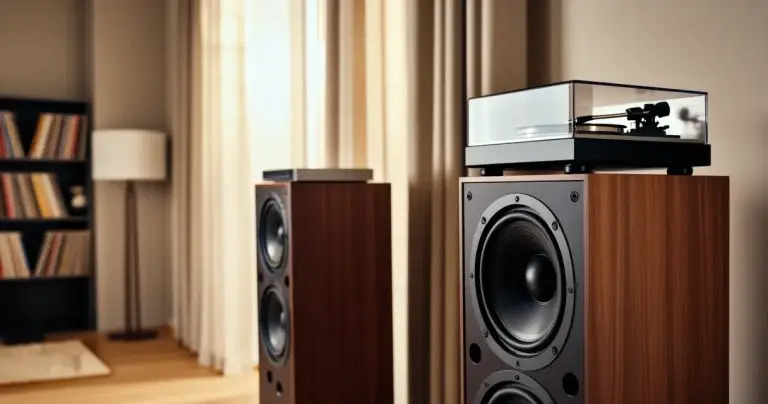
Above the mainstream soundbar category, dedicated home theater speaker packages remain the reference point for buyers who want a discrete, non-bar surround system. Current 2026 buying-guide coverage lists the Bowers & Wilkins 603 S3 tower speaker at approximately $2,700 per pair as a recommended home-theater-buyer pick, alongside the Wharfedale Diamond 12.2i bookshelf speaker at roughly $325 per pair for rooms that already have a subwoofer in place. HomeTheaterHiFi.com’s 2026 recommended gear list spans a wide range, with entries from roughly $1,298.50 up to $50,000 at the extreme high end, illustrating just how much price spread exists once you move outside the mainstream soundbar category into full component-based home theater builds.
For most buyers this reference tier is aspirational rather than practical — the gap between a $280 average soundbar and a $2,700-per-pair tower speaker setup (which also requires a separate AV receiver, additional surrounds, and a subwoofer) is enormous. But it’s a useful ceiling to understand: it tells you that the premium soundbar segment, priced above $300 and carrying an estimated 35% to 40% of category revenue, is still a relative bargain compared to true component separates, even if it can’t fully replicate their performance.
Soundbar vs. Full Surround System vs. Bookshelf-Based Setup
What Hi-Fi’s 2026 surround sound coverage makes a point worth taking seriously: while plenty of soundbars can replicate a surround-sound experience to a degree, they generally cannot fully match the performance of a proper multi-speaker package with a real AV receiver driving discrete channels. That’s a qualitative, editorial judgment from that outlet rather than a blind-tested measurement, but it lines up with the basic physics — a single bar, no matter how many virtual channels it claims, is still one enclosure trying to simulate directional sound that dedicated, spatially separated speakers reproduce natively.
The decision tree in practice looks roughly like this:
- Renters and small apartments: A 2.1 or 3.1 soundbar remains the most sensible choice — no drilling, no receiver, simple setup, and current average pricing around $230–$280.
- Dedicated movie room, willing to run some cable or use wireless rears: A 5.1 soundbar system with satellite speakers, or a proper bookshelf-plus-subwoofer setup paired with an AV receiver, both outperform a bar-only solution for actual channel separation.
- Reference-quality home theater, budget not the primary constraint: Component separates — towers or bookshelf speakers plus a dedicated subwoofer and AV receiver — remain the ceiling, as reflected in the $1,298 to $50,000 range on HomeTheaterHiFi’s 2026 recommended gear list.
If you’re weighing a full receiver-driven system over a soundbar, our AV receiver buying guide covers the component side of that decision in more depth, including phono-stage-equipped models relevant if vinyl playback is part of the same room’s setup.
Where Soundbars Intersect With a Turntable-Based Listening Room
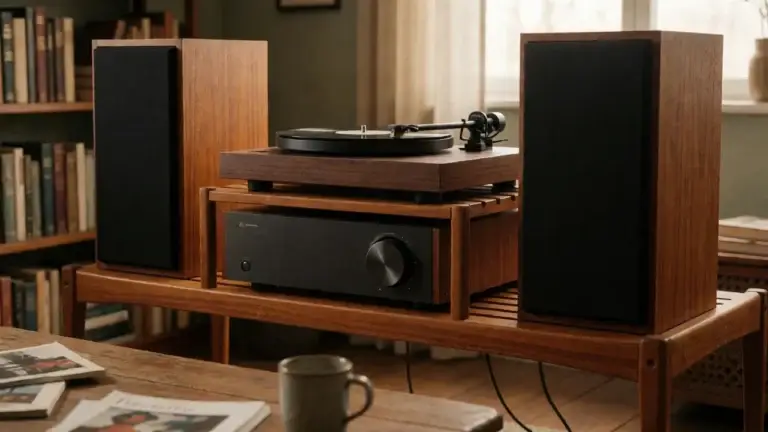
A growing number of soundbar buyers are also vinyl listeners trying to consolidate their living room into a single system rather than running a separate hi-fi stereo setup. This is a real tension: most soundbars are designed around a TV’s optical or HDMI-ARC output and are not built to accept a phono-level or even line-level turntable signal directly. If your turntable doesn’t have a built-in preamp, you generally need an outboard phono preamp between the turntable and the soundbar’s aux or optical input, and even then, a soundbar’s tuning — usually voiced for movie dialogue and effects rather than musical imaging — will not deliver the same soundstage as a dedicated stereo pair.
For readers trying to decide whether a soundbar can double as their vinyl listening setup or whether they need a separate stereo path, it’s worth reading our coverage on phono preamps for the signal-chain side, and our home stereo system guide for how a dedicated music-first setup compares in cost and performance to a soundbar-centric room. Generally speaking, a soundbar is optimized for a completely different listening task than a turntable-and-speaker pair, and treating the two as interchangeable will disappoint vinyl listeners more than TV-audio listeners.
Specification Checklist: What to Actually Look For
Retail soundbar listings are frequently vague about the specs that matter most. Use this checklist when comparing product pages side by side:
- Channel notation (e.g. 3.1, 5.1.2, 7.1.4): confirms actual driver count, not just marketing language like “virtual surround” or “3D audio.”
- Physical upward-firing drivers vs. virtualization-only Atmos: check the spec sheet for a stated number of “height” or “up-firing” drivers; if none are listed, the Atmos support is processing-based only.
- Subwoofer connection type: wireless is now standard across essentially all tiers, but confirm it explicitly if buying a lower-cost or older-stock model.
- HDMI eARC support: required to pass lossless Atmos audio from a 2026 TV back to the soundbar; optical-only connections cap out at compressed formats.
- Center channel presence: distinguishes a true 3.1 from a 2.1 with a “dialogue mode” DSP setting — they are not the same thing.
- Rear satellite compatibility: some 2.1/3.1 bars can be expanded later with add-on wireless rears; check whether the manufacturer sells a matching accessory before assuming upgrade-in-place is possible.
Room Size and Placement: The Variable Every Spec Sheet Ignores
No channel count or driver spec can overcome poor placement. Upward-firing Atmos drivers rely on a flat, reasonably low ceiling — typically under roughly 12 feet, though manufacturers rarely publish an exact usable ceiling height — to reflect sound back down to the listening position. A vaulted, angled, or very high ceiling will significantly reduce or eliminate the overhead effect regardless of how many height channels the bar claims. Similarly, wireless rear satellites in a 5.1 or 7.1 configuration need to be placed to the side or slightly behind the main seating position, not directly behind a couch pushed against a back wall, to deliver real channel separation rather than a blended wash of sound.
This is the same principle that applies to bookshelf speaker placement for music listening — a topic we cover in detail in our bookshelf speakers for vinyl guide — where toe-in angle and distance from rear walls matter as much as the speaker’s own driver specifications.
Budget Tiers: What Your Money Buys at Each Price Point
| Budget Tier | Typical Configuration | What You Get | What You Give Up |
|---|---|---|---|
| Under $250 | 2.1, wireless sub | Meaningful upgrade over TV speakers, easy setup | No dedicated center channel, no Atmos height |
| $250–$300 (category average) | 3.1, wireless sub | Dedicated dialogue channel, better clarity in dialogue-heavy content | Still no true height channels in most models at this tier |
| $300+ (premium, ~35–40% of revenue) | 5.1 or 7.1.2/7.1.4, Atmos height drivers, wireless rears | Real surround separation, physical height drivers, HDMI eARC | Diminishing returns without a suitable flat, low ceiling |
| Component separates ($1,300+) | AV receiver + discrete speakers + subwoofer | Reference-level channel separation and imaging | Installation complexity, cable runs, much higher total cost |
Limitations of This Guide
This article does not include first-hand listening tests, measured frequency response, or lab-calibrated comparisons of specific soundbar models — those figures belong to the outlets that conducted them (Wirecutter and What Hi-Fi are cited above for their own testing claims, clearly attributed as such). It also does not cover installation instructions for HDMI-ARC vs. eARC setup, TV-specific compatibility quirks, or app-based room calibration systems, which vary significantly by manufacturer and are worth researching against your specific TV model before buying. Market-size figures cited here are industry estimates from research firms and vary somewhat between sources, as shown by the differing 2026 North America market-size estimates from Global Market Insights ($2.48B) and Morgan Reed Insights ($3.8B) — we’ve presented both rather than picking one as more authoritative.
The Bottom Line for 2026 Buyers
The Dolby Atmos soundbar category has matured into a genuinely tiered market rather than a one-size-fits-all product. At the category average of $230 to $280, a 2.1 or increasingly a 3.1 configuration with a wireless subwoofer covers the vast majority of apartment and small-living-room needs, and the shrinking share of bare 2.1 systems suggests most buyers are already voting with their wallets for the added center channel. Above $300, where an estimated 35% to 40% of category revenue now sits, physical height drivers and wireless rear satellites deliver a real step up in immersion — but only in rooms with a ceiling suited to reflect that overhead sound. And for buyers chasing genuine reference-level performance, component separates starting around $1,300 and extending into five-figure territory remain the ceiling that no soundbar, however many virtual channels it claims, fully replicates.
Whichever tier you land in, cross-check the actual channel notation and driver count against the manufacturer’s spec sheet rather than marketing copy, confirm HDMI eARC support if you want lossless Atmos from a modern TV, and factor in your ceiling height and room shape before assuming a higher channel count will automatically sound better in your specific space.
Related Reading
- Best AV Receivers for 2026: The Real-World Buying Guide
- Best Bookshelf Speakers for Vinyl in 2026: Spec-Led Picks for Every Budget
- Best Phono Preamps for 2026: Spec-Led Picks From $99 to $499
- Best Home Stereo System for Music: Three Routes and What They Cost
- Best Amplifier for Turntable in 2026: The Complete US Buying Guide
- Marantz CINEMA 70s Series 2 Review: Is It Worth $200 More?
Sources: IndexBox United States Soundbar Market Analysis (2026); IndexBox Soundbar Home Theater Market Report (2026); IndexBox Professional Soundbar Market Report (2026); Global Market Insights North America Soundbars Market (2026); Morgan Reed Insights North America Soundbars Market (2026); ResearchAndMarkets Soundbars Market Report (2026); SourceReady US Audio Devices Market Report (2026); Wirecutter, “The 4 Best Soundbars of 2026”; What Hi-Fi, “Best surround sound systems 2026” and “Best speakers 2026”; HomeTheaterHiFi.com Recommended Gear List 2026; cinemaconfig.com, “Best Home Theater Speakers (2026 Picks).”