Summary
✓Reviewed by David Chen If your records sound thin, harsh, or oddly distant even on a turntable you like, the problem usually isn't the turntable at all. It's the stylus tip that's actually sitting in the groove. As of September...
Table of Contents
- 1 Direct Answer: What’s the Best Turntable Cartridge Upgrade in 2026?
- 2 Why the Cartridge Matters More Than the Turntable Body
- 3 Cartridge vs. Stylus: What You’re Actually Replacing
- 3.1 The Audio-Technica VM95 Family
- 3.2 The Ortofon 2M Family
- 4 2026 Cartridge Comparison Table
- 5 How Much Should You Actually Spend on a Cartridge?
- 6 Can Your Turntable Even Accept a New Cartridge?
- 7 Setup Mistakes That Waste a Good Cartridge Upgrade
- 7.1 Alignment Basics
- 7.2 Tracking Force
- 8 Cartridge Upgrades for Damaged or Thrifted Records
- 9 DJ Cartridges and Headphones: A Related but Separate Category
- 10 Cost Breakdown: What a Cartridge Upgrade Actually Costs Over Time
- 11 A Practical Decision Framework for 2026 Buyers
- 12 Where a Cartridge Upgrade Fits Into a Broader System
- 13 Limitations of This Guide
- 14 The Bottom Line
- 14.1 Related Reading
- 14.2 References
If your records sound thin, harsh, or oddly distant even on a turntable you like, the problem usually isn’t the turntable at all. It’s the stylus tip that’s actually sitting in the groove. As of September 15, 2026, the single most cost-effective upgrade available to most vinyl listeners is a cartridge or stylus swap, not a new deck. This guide breaks down exactly which cartridges are worth buying this year, how to tell if your turntable can even accept an upgrade, and how to avoid the setup mistakes that make a better cartridge sound worse than the one it replaced.
Direct Answer: What’s the Best Turntable Cartridge Upgrade in 2026?
For most budget and mid-range turntables, the Audio-Technica AT-VM95E is the highest-return single upgrade available, since it replaces a stock conical stylus with an elliptical tip on a body that accepts further stylus upgrades later without buying a new cartridge, according to 2026 buying-guide coverage.[1][2] For turntables in the $400 to $1,000 range with adjustable tonearms, the Ortofon 2M Red is the commonly recommended step up, with a direct, tool-free upgrade path to the sharper 2M Blue stylus later.[3][4] Below, we walk through the full decision tree, real prices, and the setup details that determine whether any of these swaps actually pays off.
How we know: the facts, prices, and product details in this article are drawn from cartridge buying guides, retailer listings, and reviews published between February 2025 and September 2026, cited by name throughout. We have not personally bench-tested every cartridge named here; where a claim comes from a manufacturer spec sheet or a third-party review rather than our own listening session, that is stated plainly.
Why the Cartridge Matters More Than the Turntable Body
The stylus is the only part of your entire audio chain that physically touches the record. Every other component — plinth, platter, tonearm tube, even the motor — only matters insofar as it keeps that stylus tracking the groove accurately. A 2026 buying guide from Platter & Plinth makes the point bluntly: the stylus at the end of your cartridge is the most cost-effective upgrade you can make to an existing system, because it is the one part of the signal chain making direct physical contact with the music.[5]
This matters because most entry-level turntables — including many popular models covered in our beginner turntable guide — ship with a conical stylus. Conical tips are cheap to manufacture and forgiving of minor alignment errors, but they trace only a small portion of the groove wall, which is where high-frequency detail and inner-groove distortion live. Swapping to an elliptical, MicroLinear, or Shibata tip lets the stylus contact more of the groove surface at the same vertical position the record was cut with, which is why listeners often describe an upgraded stylus as sounding “clearer” or “less harsh” rather than simply louder.
A 2026 New York Times Wirecutter guide to shopping for a turntable notes that a typical phono cartridge lasts between 800 and 1,200 hours of listening before the stylus wears enough to affect sound quality and, eventually, damage records.[6] For a listener playing two hours of vinyl a day, that’s roughly one to one-and-a-half years before a replacement stylus is needed even without an intentional upgrade — which means most vinyl collectors will face this decision whether they seek it out or not.
Cartridge vs. Stylus: What You’re Actually Replacing
One point of confusion 2026 buying guides consistently flag: the stylus is the replaceable diamond tip and cantilever assembly, while the cartridge is the entire body that houses the magnets and coils and converts the stylus’s physical movement into an electrical signal.[7] On most moving-magnet (MM) cartridges, the stylus assembly clips out and a new one clips in without removing the cartridge body itself or requiring you to rewire anything.
This distinction is the entire reason the Audio-Technica VM95 series and Ortofon 2M series have become the default recommendations in 2026 coverage: both use a shared body across multiple price points, so a listener can buy the cheapest stylus now and upgrade to a sharper tip later by swapping only the $50 to $130 stylus, not the $40 to $60 cartridge body underneath it.[8]
The Audio-Technica VM95 Family
According to 2026 coverage from SK Records, the VM95 series uses one common cartridge body across four stylus tiers: conical (VM95C), standard elliptical (VM95E), MicroLinear (VM95ML), and Shibata (VM95SH), letting a buyer swap the stylus tip without buying a new cartridge each time.[9] The entry-level AT-VM95C is described in that same coverage as costing under $60 and being a forgiving choice for worn or thrifted records, since its rounder conical tip is less sensitive to groove wear than a sharper elliptical or line-contact stylus.[9]
A separate 2026 guide from Platter & Plinth calls the AT-VM95E the single highest-return upgrade for a budget turntable still running its stock conical stylus, while identifying the AT-VM95ML as the largest sonic jump available under $200 for buyers willing to spend more.[2]
The Ortofon 2M Family
The Ortofon 2M Red sits a tier above the VM95 range and is frequently recommended in 2026 coverage for owners of Rega and Pro-Ject turntables specifically, at a street price of roughly $103–104.[3][10] Vinyl Pickup’s 2026 review of the 2M Red confirms that its body accepts a direct swap to the sharper 2M Blue stylus at any point, with no tools required and no need to realign the cartridge afterward, since the stylus mounts in the same physical position.[4]
At the top of that same family, the Ortofon 2M Black is positioned in 2026 coverage as a statement moving-magnet cartridge intended only for turntables and systems in the $1,000-plus range, at a price point around $749.[3] That price gap illustrates why buyers are consistently advised not to treat cartridge shopping as a single decision — the 2M name spans a roughly 7x price range depending on the stylus profile installed.
2026 Cartridge Comparison Table
| Cartridge | Type | Stylus | Approx. Price (2026) | Best For |
|---|---|---|---|---|
| Audio-Technica AT-VM95C | Moving magnet | Conical | Under $60 | Worn or thrifted records, starter upgrade |
| Audio-Technica AT-VM95E | Moving magnet | Elliptical | ~$70–$80 | Budget decks with stock conical stylus |
| Audio-Technica AT-VM95ML | Moving magnet | MicroLinear | Under $200 | Biggest sonic jump under $200 |
| Ortofon 2M Red | Moving magnet | Elliptical | ~$103–$104 | Rega/Pro-Ject owners, mid-tier decks |
| Ortofon 2M Blue (stylus swap) | Moving magnet | Nude elliptical | Stylus-only upgrade on 2M Red body | 2M Red owners wanting more detail, no tools needed |
| Ortofon 2M Black | Moving magnet | Shibata | ~$749 | Systems and turntables $1,000+ |
Source: Platter & Plinth 2026 cartridge guides, SK Records 2026 cartridge-for-worn-records guide, Vinyl Pickup 2026 cartridge and 2M Red review roundups.[2][3][4][9]
How Much Should You Actually Spend on a Cartridge?
A 2025 What Hi-Fi guide offers a rule of thumb that’s still cited in 2026 coverage: a cartridge’s price should land at roughly one quarter to one third of the turntable’s own price.[11] Under that formula, a $300 turntable pairs sensibly with a $75–$100 cartridge, while a $150 upgrade cartridge would be disproportionate to the rest of the chain — you’d be limited by the tonearm and plinth long before the cartridge became the weak link.
The same guide draws a line at moving-magnet versus moving-coil (MC) design: for turntables under roughly $1,000 to $1,200 (originally quoted as under £1,000), it’s usually best to stick with moving-magnet cartridges, while moving-coil cartridges only start to make sense on turntables and systems around $1,500 to $1,800 (originally £1,500) and above.[11] Moving-coil cartridges are more expensive to build, typically require a step-up transformer or a phono preamp with an MC-capable input, and offer diminishing returns on tonearms and plinths that weren’t designed to resolve the extra detail they can extract. If you’re still shopping for the amplification side of that chain, our phono preamp buying guide covers which preamp inputs support MM versus MC cartridges.
New York Times Wirecutter’s 2026 turntable shopping guide adds useful context on the top of the market: cartridges like the Sumiko Rainier can cost $150 to $200, while professional and audiophile-grade cartridges reach into the five-figure range.[6] For the overwhelming majority of home listeners, though, the meaningful upgrades happen well under $200, and the returns above that point flatten out quickly unless the rest of the system — turntable, tonearm, phono stage, speakers — is built to match.
Can Your Turntable Even Accept a New Cartridge?
This is the step most buying guides bury, and it’s the one that actually determines whether any of the cartridges above are relevant to you. A 2026 Platter & Plinth guide to cartridges under $200 states the requirement plainly: your turntable needs an adjustable tonearm — meaning a counterweight to set tracking force and, ideally, an anti-skate adjustment — before a cartridge swap is possible at all.[12]
Fully automatic turntables with fixed, non-adjustable tonearms cannot accept a different cartridge; the same guide’s honest advice for owners of those decks is to save toward a turntable that supports cartridge changes rather than trying to force an upgrade onto hardware that wasn’t designed for it.[12] This is a common trap with many all-in-one and suitcase-style turntables, including some of the models discussed in our record player with built-in speakers guide — convenience-focused decks frequently sacrifice tonearm adjustability, which caps their upgrade path permanently.
Before buying any replacement cartridge, confirm three things about your existing setup, as outlined in a September 2026 Battle of Soho buying guide:[1]
- Your tonearm’s compliance range and effective mass, which determine which cartridge weights and stiffnesses will track properly
- Your phono preamp’s input type — whether it accepts moving-magnet only, or both moving-magnet and moving-coil signals
- Your cartridge’s required tracking force range and whether your tonearm’s counterweight can be set precisely enough to hit it
Setup Mistakes That Waste a Good Cartridge Upgrade
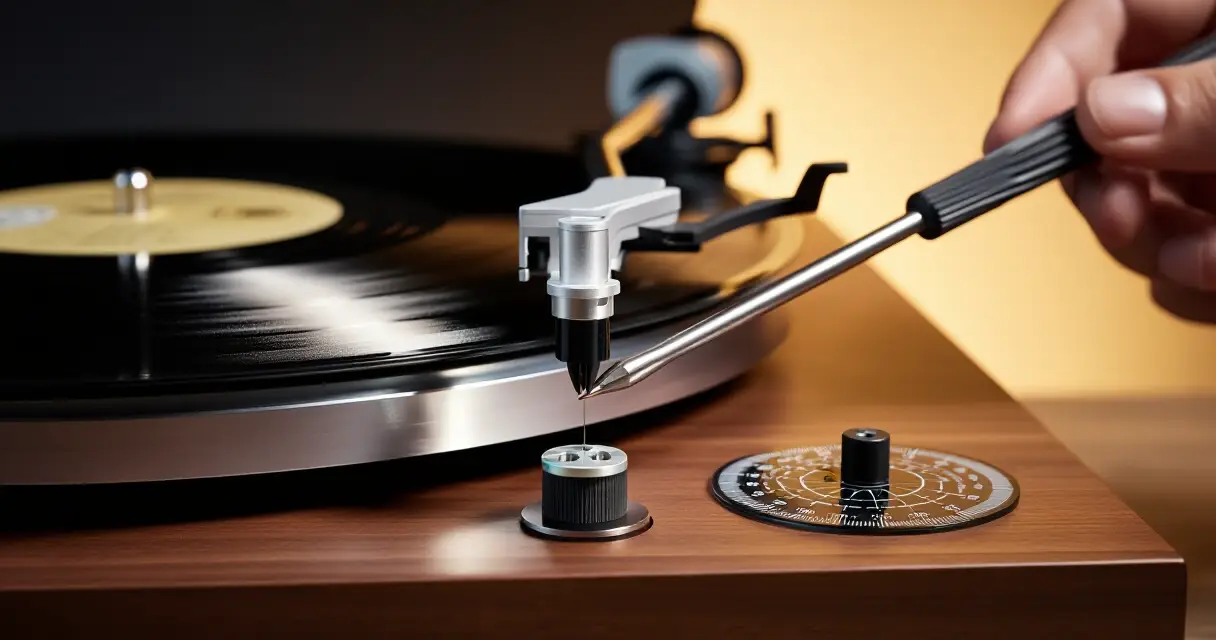
A brand-new cartridge installed carelessly can sound worse than the worn stylus it replaced. The September 2026 Battle of Soho guide highlights two setup tools that separate a properly installed cartridge from a poorly aligned one: a cartridge alignment protractor, used to set the stylus’s angle and overhang against the tonearm’s pivot point, and a digital scale, used to set tracking force precisely rather than trusting the turntable’s built-in counterweight dial.[1]
Counterweight dials are calibrated at the factory for a specific cartridge weight, and swapping in a cartridge of a different mass — which is common, since aftermarket cartridges rarely weigh exactly what the stock one did — throws that calibration off. A digital tracking force scale, typically priced well under $30, removes the guesswork and prevents both groove wear from excessive tracking force and mistracking distortion from insufficient force.
Alignment Basics
A protractor helps you position the cartridge in its headshell so the stylus’s angle relative to the groove matches the geometry the tonearm was designed around. Even a well-chosen cartridge — say, an Audio-Technica AT-VM95ML on a compatible turntable — will underperform, or even skip and mistrack, if it’s mounted a few degrees off from correct alignment. This single step is free (protractors are often included with new cartridges or cost a few dollars) and is the most commonly skipped part of a DIY upgrade.
Tracking Force
Every cartridge ships with a manufacturer-specified tracking force range, typically given in grams (for example, 1.8 to 2.2 grams). Setting force at the low end of that range reduces record wear but increases the risk of the stylus skipping on warped or heavily modulated passages; setting it at the high end improves tracking stability at the cost of slightly faster stylus and groove wear. A digital scale lets you dial in a specific number within that range rather than approximating it with a dial that may not even be calibrated for your new cartridge’s weight.
Cartridge Upgrades for Damaged or Thrifted Records
Not every buyer is chasing maximum fidelity — many are trying to get usable playback out of a stack of secondhand or heavily played records. September 2026 coverage from SK Records addresses this directly, recommending conical-stylus cartridges like the AT-VM95C specifically because their rounder, blunter tip profile is less likely to dig into groove damage that a sharper elliptical or line-contact stylus would catch and mistrack on.[9]
This is a case where “upgrade” doesn’t mean “sharpest available tip.” A worn record collection can genuinely play back more cleanly, with less surface noise and skipping, on a forgiving conical stylus than on a premium elliptical or Shibata tip that resolves detail — including groove damage — with more precision than the source material can support. If your collection is largely secondhand, this is worth weighing against the instinct to buy the most expensive cartridge your budget allows.
DJ Cartridges and Headphones: A Related but Separate Category
Home listening cartridges and DJ cartridges solve different problems, and it’s worth being clear about that distinction before buying. DJ setups prioritize higher tracking force and mistracking resistance to survive scratching, back-cueing, and quick needle drops — attributes that would be counterproductive for a home listener trying to minimize record wear over years of casual play.
On the monitoring side, 2026 coverage from The DJ Shop’s buyer’s guide ranks DJ headphones on sound quality, comfort, durability, and overall value, while a companion 2026 DJ gear guide from Offbeat Inc. lists the Audio-Technica ATH-M20x as a budget headphone pick and the Audio-Technica ATH-M50x as a pro-sumer pick, alongside the Sennheiser HD 25 as a top-tier option, within an estimated headphone price range of roughly $50 to several hundred dollars depending on tier.[13][14] A 2026 guide from Recordcase.de notes that buyers should check for single-sided cable routing to reduce clutter, a detachable cable so a damaged cord doesn’t require replacing the whole headphone, and the correct plug size — DJ mixers commonly use 6.3mm connections while controllers often use 3.5mm.[15]
Cost Breakdown: What a Cartridge Upgrade Actually Costs Over Time
| Upgrade Path | Initial Cost | Future Stylus-Only Upgrade Cost | Total Cost of Ownership Note |
|---|---|---|---|
| VM95C → VM95E → VM95ML | Under $60 | ~$70–$130 per stylus swap | Same body reused across all three tiers, per SK Records 2026 coverage[9] |
| 2M Red → 2M Blue | ~$103–$104 | Stylus-only swap, no tools/realignment | Confirmed tool-free swap per Vinyl Pickup’s 2026 review[4] |
| New cartridge every time (no shared body) | Full price each time | Full price each time | Common with non-modular cartridges; no stylus-only upgrade path |
The practical takeaway from this comparison: choosing a cartridge with a shared body and modular stylus system — as both the VM95 and 2M families offer — turns a single purchase decision into a multi-year upgrade path where only the $50–$130 stylus needs replacing as your budget or ambitions grow, rather than the full $60–$750 cartridge each time.
A Practical Decision Framework for 2026 Buyers
Based on the pricing and compatibility guidance above, here’s a simplified way to approach the decision:
- Confirm your tonearm is adjustable (has a counterweight and, ideally, anti-skate). If it isn’t, no cartridge upgrade is possible on that deck.[12]
- Check your phono preamp’s input type (MM-only, or MM/MC switchable) before considering any moving-coil cartridge.
- If your turntable costs under roughly $1,000–$1,200, shop moving-magnet cartridges only, per the 2025–2026 rule of thumb.[11]
- Budget the cartridge at about a quarter to a third of your turntable’s price.[11]
- If your collection includes worn or thrifted records, consider a conical stylus before jumping to elliptical or line-contact tips.[9]
- Buy a $20–$30 digital tracking-force scale and a cartridge alignment protractor before installation — not after something sounds wrong.[1]
- Favor a modular body (VM95 or 2M family) if you expect to upgrade the stylus again within a few years.[8]
Where a Cartridge Upgrade Fits Into a Broader System
A cartridge upgrade is most audible when the rest of the signal chain can actually reveal the difference. If you’re running a stock cartridge into budget bookshelf speakers with no dedicated phono stage, the upgrade will still help, but it will be more noticeable once paired with the right amplification and speakers. Our bookshelf speakers for vinyl guide and turntable amplifier guide cover the rest of that chain in more depth, and our home stereo system guide lays out how these pieces fit together at different budget tiers.
For listeners still deciding between a wired setup and a wireless one, it’s worth noting that Bluetooth turntables generally compress the audio signal before it reaches your speakers, which somewhat limits how much a premium cartridge upgrade can be heard compared to a fully wired analog chain — another reason cartridge shopping and turntable shopping are worth doing together rather than as two separate decisions.
Limitations of This Guide
This guide focuses on moving-magnet cartridges in the sub-$200 range plus a handful of well-documented reference points above that, because that’s where the vast majority of home turntable owners are shopping in 2026. It does not cover high-end moving-coil cartridges above roughly $750, step-up transformer selection, or the mechanical nuances of tonearm resonance matching, which require case-by-case measurement rather than general guidance. We also have not independently bench-tested the tracking performance of every cartridge named here; figures and rankings are drawn from the named 2025–2026 sources cited throughout, not from our own lab measurements.
The Bottom Line
As of September 15, 2026, the most reliable path to better vinyl sound for most listeners isn’t a new turntable — it’s confirming your tonearm is adjustable, then choosing a modular cartridge like the Audio-Technica VM95 or Ortofon 2M family that lets you upgrade the stylus alone as your budget allows. Combined with a $20–$30 tracking force scale and a basic alignment protractor, a $60–$130 stylus upgrade remains one of the few purchases in this hobby that reliably delivers an audible difference for a modest price. Skipping the alignment and tracking-force steps, on the other hand, is the single most common way buyers waste the money they just spent on a better cartridge.
Related Reading
- Best Turntable for Beginners: What to Buy in 2026 (and What to Avoid)
- Best Phono Preamps for 2026: Spec-Led Picks From $99 to $499
- Best Bookshelf Speakers for Vinyl in 2026: Spec-Led Picks for Every Budget
- Best Turntable Under $500: What the Extra Money Buys (2026)
- Best Record Player with Speakers: All-in-One vs Separates (2026)
- Best Home Stereo System for Music: Three Routes and What They Cost
- Best Bluetooth Turntables for 2026: Wireless Vinyl Without the Compromise
References
- Battle of Soho, “8 Best Turntable Cartridges (September 2026) Better Sound Guide” — battleofsoho.com
- Platter & Plinth, “Best Turntable Cartridges” and “Best Turntable Cartridges Under $200” — platterandplinth.com
- Vinyl Pickup, “Best Turntable Cartridges of 2026” and “Ortofon 2M Red Review 2026” — vinylpickup.com
- What Hi-Fi, “Best cartridges 2025: budget and premium options for your turntable” — whathifi.com
- New York Times Wirecutter, “How to Shop for a Quality Turntable in 2026” — nytimes.com/wirecutter
- SK Records, “10 Best Cartridges for Worn or Thrifted Records (September 2026)” — skrecords.org
- The DJ Shop, “Best DJ Headphones for 2026” — thedjshop.co.uk
- Offbeat Inc., “Beginner DJ Setup Guide 2026” — offbeatinc.com
- Recordcase.de, “The best DJ headphones 2026 compared” — recordcase.de