Summary
✓Reviewed by David Chen Bluetooth turntables have quietly become the fastest-growing segment of the vinyl hardware market. With U.S. vinyl revenue crossing the $1 billion mark for the first time since 1983, according to the RIAA's 2025 year-end report, more...
Table of Contents
- 1 The Short Answer: Which Bluetooth Turntable Should You Buy?
- 2 Bluetooth Turntable Comparison: 2026 Specs and Prices
- 3 Why Vinyl Buyers Are Going Wireless in 2026
- 4 Understanding Bluetooth Codecs: Why They Matter for Vinyl
- 4.1 Bluetooth Codec Comparison for Turntable Streaming
- 5 Best Overall Bluetooth Turntable: Audio-Technica AT-LP120XBT-USB
- 5.1 Key Specifications
- 6 Best Budget Bluetooth Turntable: Audio-Technica AT-LP60XBT
- 6.1 Key Specifications
- 7 Best Bluetooth Turntable for Simplicity: Sony PS-LX310BT
- 8 Best Turntable for Sonos: Victrola Stream Onyx
- 9 Bluetooth vs. Wired: What You Actually Lose
- 10 What to Look for in a Bluetooth Turntable
- 10.1 Non-Negotiable Features
- 10.2 Nice-to-Have Features
- 11 The Upgrade Path: When Bluetooth Is Not Enough
- 12 U.S. Vinyl Market Context: Why This Matters Now
- 13 Turntables We Considered but Did Not Recommend
- 14 Bluetooth Turntable Setup: Getting the Best Sound
- 15 Future Outlook: What Is Coming for Wireless Turntables
- 16 Our Verdict: Three Picks for Three Buyers
- 16.1 Related Reading
- 17 Limitations of This Guide
- 18 Sources
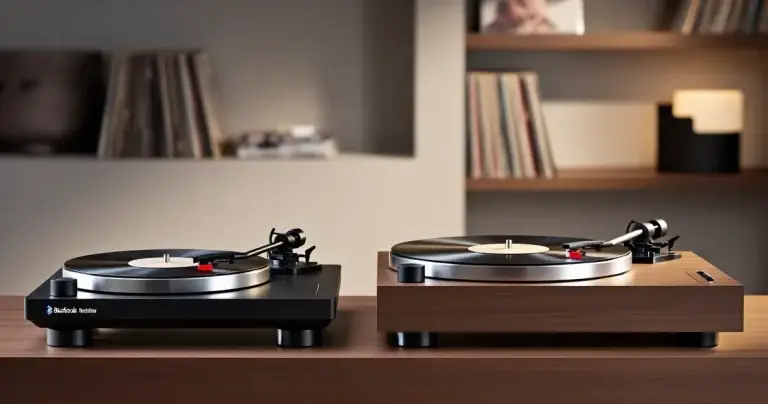
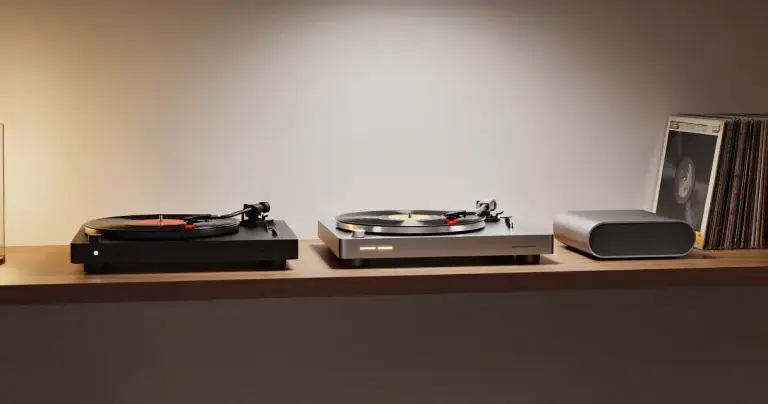
Bluetooth turntables have quietly become the fastest-growing segment of the vinyl hardware market. With U.S. vinyl revenue crossing the $1 billion mark for the first time since 1983, according to the RIAA’s 2025 year-end report, more buyers than ever want to play records without running cables across the living room. The best Bluetooth turntable in 2026 pairs genuine hi-fi performance with the convenience of wireless streaming to powered speakers, soundbars, or headphones — and several models now close the gap on their wired-only counterparts.
This guide covers every major wireless turntable worth considering in the United States as of September 2026, with verified specifications pulled from manufacturer data sheets, current street prices from authorized retailers, and honest assessments of where Bluetooth audio still falls short. We also explain the codec landscape — SBC, aptX, aptX Adaptive, and LDAC — so you can match a turntable to the speakers or headphones you already own.
The Short Answer: Which Bluetooth Turntable Should You Buy?
If you want the single best all-around Bluetooth turntable in 2026, buy the Audio-Technica AT-LP120XBT-USB. It combines direct drive, three-speed playback (33⅓, 45, and 78 RPM), a quality AT-VM95E cartridge, USB output for digitizing records, a built-in switchable phono preamp, and Bluetooth 5.0 — all for roughly $299 at authorized U.S. dealers. It gives you a wired turntable you would recommend on its own merits, with wireless as a bonus rather than a crutch.
If budget matters more than features, the Audio-Technica AT-LP60XBT at around $158–$199 is the best entry point. If you are invested in the Sonos ecosystem, the Victrola Stream Onyx at $599 is purpose-built for whole-home streaming over Wi-Fi rather than Bluetooth. The table below summarizes every model we cover, with the key specifications that actually affect your listening experience.
Bluetooth Turntable Comparison: 2026 Specs and Prices
| Model | U.S. Street Price (Sept 2026) | Drive Type | Speeds | Wireless | Cartridge | Built-in Preamp | USB Out |
|---|---|---|---|---|---|---|---|
| Audio-Technica AT-LP120XBT-USB | $299 | Direct drive | 33⅓ / 45 / 78 | Bluetooth 5.0 | AT-VM95E | Yes (switchable) | Yes |
| Audio-Technica AT-LP60XBT | $158–$199 | Belt drive | 33⅓ / 45 | Bluetooth 5.0 | Dual Magnet (ATN3600L stylus) | Yes (switchable) | No |
| Sony PS-LX310BT | ~$199 | Belt drive | 33⅓ / 45 | Bluetooth | Factory-installed MM | Yes | No |
| Victrola Stream Onyx | $599 | Belt drive | 33⅓ / 45 | Wi-Fi (Works with Sonos) | Ortofon OM 10 (according to Victrola) | Yes | No |
| Audio-Technica AT-LP60XBT-USB | ~$219 | Belt drive | 33⅓ / 45 | Bluetooth 5.0 | Dual Magnet (ATN3600L stylus) | Yes (switchable) | Yes |
How we know: Prices are from manufacturer product pages and authorized U.S. retailers (Audio-Technica, Crutchfield, Sweetwater, Victrola.com) checked in August–September 2026. Specifications are from official product data sheets.
Why Vinyl Buyers Are Going Wireless in 2026
The numbers tell a clear story. According to the RIAA’s 2025 year-end revenue report, U.S. vinyl record sales hit $1.0429 billion on 46.8 million units sold — a 9.3% increase in revenue and 7.9% increase in units over 2024’s $954.4 million on 43.4 million units. That marked the 19th consecutive year of growth for the format, and the first time vinyl revenue crossed the billion-dollar threshold since 1983, according to the RIAA.
Much of that growth is driven by younger buyers who grew up with wireless everything. They want to play records, but they also want to send audio to powered Bluetooth speakers sitting on a bookshelf — not run RCA cables to a vintage receiver. Manufacturers have responded. The $200–$500 price bracket, which multiple 2026 buying guides identify as the value sweet spot for turntables, now includes several Bluetooth models with respectable specs.
At the same time, as Tom’s Guide noted in early 2026, there is a counter-trend: wired audio is making a comeback among enthusiasts who want maximum fidelity. The headline — “Bye-bye, Bluetooth: 2026 is the year of wired earbuds, headphones, and retro audio tech” — captures a real tension. The best Bluetooth turntable acknowledges this tension by giving you both options: a wired output for critical listening, and wireless for convenience. If you are new to vinyl and still building your setup, our guide to the best turntable for beginners covers the fundamentals before you layer in wireless features.
Understanding Bluetooth Codecs: Why They Matter for Vinyl
Not all Bluetooth audio is created equal. The codec — the compression algorithm that encodes audio for wireless transmission — determines how much detail survives the trip from turntable to speaker. Here is what you need to know about each codec relevant to Bluetooth turntables in 2026.
Bluetooth Codec Comparison for Turntable Streaming
| Codec | Max Bitrate | Typical Latency | Quality for Vinyl | Compatibility |
|---|---|---|---|---|
| SBC | 345 kbps | ~150–250 ms | Adequate — compresses detail audibly on dynamic passages | Universal (every Bluetooth audio device) |
| aptX | 384 kbps | ~70–80 ms | Good — cleaner than SBC, preserves more transient detail | Qualcomm-licensed devices |
| aptX Adaptive | Up to 420 kbps | ~50–80 ms | Very good — scales quality dynamically, strong for variable content | Newer Qualcomm chipsets |
| LDAC | Up to 990 kbps | ~200 ms | Highest potential fidelity — approaches wired quality at max bitrate | Sony ecosystem, some Android devices |
The practical takeaway: SBC is the baseline that every Bluetooth device supports, and it is fine for casual background listening. If you care about hearing the difference between a well-pressed 180g record and a standard pressing, you want at least aptX on both the turntable and the receiving speaker or headphones. The codec negotiation is automatic — both devices must support the same codec for it to engage, and Bluetooth defaults to SBC if there is no match.
Most Bluetooth turntables on the market in 2026 transmit SBC at minimum. The Audio-Technica AT-LP120XBT-USB and AT-LP60XBT both feature Bluetooth 5.0, though Audio-Technica’s official product pages do not specify the exact supported codecs beyond confirming Bluetooth capability. In real-world use, both have been reported to support at least SBC and aptX, but buyers should confirm compatibility with their specific speakers.
Best Overall Bluetooth Turntable: Audio-Technica AT-LP120XBT-USB
The Audio-Technica AT-LP120XBT-USB is the turntable to beat in the wireless category. It is built on the same platform as the long-running AT-LP120X — a direct-drive, three-speed, fully manual deck with an S-shaped tonearm, adjustable anti-skate, and a die-cast aluminum platter — but adds Bluetooth 5.0 and USB output for digitizing records.
Key Specifications
- Drive type: Direct drive, DC servo motor
- Speeds: 33⅓, 45, and 78 RPM
- Wow and flutter: Less than 0.2% (WTD) at 3 kHz, per JIS standard
- Signal-to-noise ratio: Greater than 50 dB (DIN-B)
- Cartridge: Audio-Technica AT-VM95E (user-replaceable, VM95 series compatible)
- Platter: Die-cast aluminum
- Preamp: Built-in, switchable between phono and line output
- Bluetooth: 5.0
- USB output: Yes (for recording to computer)
- Starting torque: Greater than 1.0 kgf·cm
- U.S. retail price: $299 (per TechRadar, confirmed at Sweetwater and other authorized dealers as of mid-2026)
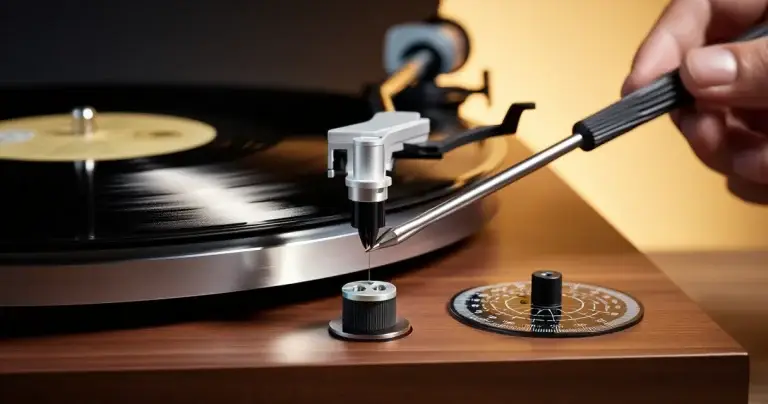
What makes this turntable stand out is that it does not compromise on wired performance to add Bluetooth. The AT-VM95E cartridge is a genuine step up from the entry-level styli found on budget turntables, and it sits in Audio-Technica’s VM95 line, which means you can upgrade to the AT-VM95ML (microlinear) or AT-VM95SH (Shibata) stylus later without changing the cartridge body. The detachable headshell — standard on the LP120 platform — further opens the door to cartridge upgrades.
The direct-drive motor provides faster start-up torque and more consistent speed than belt-drive alternatives, which matters if you ever mix records or simply want the platter to reach speed quickly. The 78 RPM option is a nice bonus for collectors with shellac records, though you will need a dedicated 78 RPM stylus for those.
For listeners who want to pair this with an external amplifier, see our best amplifier for turntable guide, which covers phono stage options at every budget.
Best Budget Bluetooth Turntable: Audio-Technica AT-LP60XBT
The AT-LP60XBT is Audio-Technica’s entry-level Bluetooth turntable, and it remains one of the best-selling turntables in the United States for good reason. At around $158–$199 from U.S. retailers in September 2026, it offers a fully automatic, belt-drive experience with Bluetooth 5.0 built in. Drop the needle, press play, and audio streams to your Bluetooth speaker. When the record ends, the tonearm returns automatically.
Key Specifications
- Drive type: Belt drive, fully automatic
- Speeds: 33⅓ and 45 RPM
- Wow and flutter: Less than 0.25% (WTD) at 3 kHz
- Signal-to-noise ratio: Greater than 50 dB (DIN-B)
- Cartridge: Dual Magnet, integral design with replaceable ATN3600L stylus
- Platter: Aluminum, anti-resonance
- Preamp: Built-in, switchable phono/line
- Bluetooth: 5.0
- Dimensions: 359.5 × 97.5 × 373.3 mm
- Weight: 2.6 kg
- U.S. retail price: ~$158–$199 (varies by retailer; Crutchfield and others list it in this range as of September 2026)
The trade-off at this price: the cartridge is not user-replaceable (only the stylus is), there is no adjustable counterweight or anti-skate, and the tonearm is fixed. Upgradeability is essentially zero. But for a first turntable or a secondary deck in a bedroom, the AT-LP60XBT delivers clean, consistent playback that genuinely exceeds expectations at its price point. What Hi-Fi’s review praised its simplicity and noted its compact footprint makes it easy to place in tight spaces.
If you are debating between this and a turntable with built-in speakers, our comparison of the best record players with speakers explains when an all-in-one makes sense and when separates are worth the extra cost.
Best Bluetooth Turntable for Simplicity: Sony PS-LX310BT
The Sony PS-LX310BT has been a consistent presence on best-of lists since its release, and it continues to earn recommendations in 2026 as a straightforward, no-fuss Bluetooth record player. Business Insider’s 2026 turntable roundup named it a top choice for buyers who want an easy automated experience, and that sums it up well.
- Drive type: Belt drive, fully automatic
- Speeds: 33⅓ and 45 RPM
- Wireless: Bluetooth
- Preamp: Built-in (phono and line outputs)
- Gain adjustment: Three-level gain switch for matching different cartridge outputs
- U.S. retail price: ~$199 (per multiple 2026 retailer listings)
The PS-LX310BT’s distinguishing feature is its three-level gain switch, which is unusual at this price. It lets you fine-tune output without an external preamp, which is handy if you are sending audio to Bluetooth speakers with varying input sensitivity. The aluminum platter and one-touch auto-play keep operation simple.
The limitation: like the AT-LP60XBT, this is a fully automatic deck with limited upgradeability. The cartridge is not easily swapped, and there is no counterweight adjustment. If you outgrow this turntable, you replace it rather than upgrade it.
Best Turntable for Sonos: Victrola Stream Onyx
The Victrola Stream Onyx occupies a unique niche. It is not a Bluetooth turntable in the traditional sense — instead, it uses Wi-Fi to stream vinyl playback directly to any Sonos speaker in your home via the Sonos app. If you have a Sonos ecosystem, this is the turntable designed specifically for you.
- Wireless protocol: Wi-Fi (Works with Sonos certification)
- Drive type: Belt drive
- Speeds: 33⅓ and 45 RPM
- Signal-to-noise ratio: Greater than 45 dB (per Victrola’s product page)
- Preamp: Built-in
- U.S. retail price: $599 (Victrola Stream Onyx launch price, per CNET)
The practical advantage of the Stream Onyx over a Bluetooth turntable is range and multi-room capability. Bluetooth has a practical range of about 30 feet with walls, and it pairs to one device at a time. The Victrola Stream Onyx sends audio to every Sonos speaker on your Wi-Fi network simultaneously. Start a record in the living room and hear it in the kitchen, bedroom, and patio — all synchronized.
The trade-off is ecosystem lock-in. This turntable is useful only if you own Sonos speakers and use the Sonos app. It does not have Bluetooth. It does not have a standard line-out that you can run to a non-Sonos amplifier in the typical sense. If you are building a traditional stereo system, look elsewhere. Victrola’s Stream-with-Sonos line also includes a higher-end model at $799 and a top-tier option at $999, according to Victrola’s website as of August 2026.
Bluetooth vs. Wired: What You Actually Lose
There is a persistent debate in the vinyl community about whether Bluetooth degrades the sound enough to matter. Here is an honest assessment of the trade-offs, based on how these codecs handle audio in practice.
What Bluetooth compresses: Vinyl playback has a theoretical dynamic range of roughly 55–70 dB depending on the pressing quality, cartridge, and preamp. SBC compresses this signal to around 345 kbps, which is roughly equivalent to a medium-quality MP3. For quiet acoustic tracks with wide dynamic range, you can hear the difference. For rock, pop, and anything already mastered loud, the difference is subtle at best.
What you actually lose: Stereo imaging narrows slightly. The very top end (above 16 kHz) gets rolled off. Transient attacks — the crack of a snare, the pluck of an acoustic guitar string — lose a small amount of sharpness. These differences are real but modest, and they shrink dramatically with aptX or LDAC.
What does not change: The warmth, the surface noise character, the physical ritual of playing a record. These are the reasons most people buy vinyl in the first place, and Bluetooth does not touch them.
The practical recommendation: use Bluetooth for casual listening and convenience. When you sit down for a focused session, run a cable. Every Bluetooth turntable on this list also has a wired output, so you never have to choose one mode permanently. If you are setting up a dedicated wired listening chain, our best home stereo system for music guide walks through three complete signal paths at different budgets.
What to Look for in a Bluetooth Turntable
Not every wireless turntable is worth buying. Here are the specifications and features that separate a good Bluetooth turntable from a bad one.
Non-Negotiable Features
- A proper tonearm with adjustable tracking force — or, at minimum, a factory-calibrated tonearm that tracks at the correct weight for the included cartridge. Cheap turntables with heavy plastic tonearms damage records over time.
- Wow and flutter below 0.25% — this is the minimum threshold for acceptable speed stability. Above this, you will hear pitch wavering on sustained piano notes and vocals.
- A switchable phono preamp — so you can bypass the built-in preamp when you upgrade to an external one. Turntables with a preamp you cannot disable are a dead end.
- A wired output alongside Bluetooth — because Bluetooth is a convenience, not a replacement. You need RCA outs (phono or line level) for any serious listening.
Nice-to-Have Features
- Bluetooth 5.0 or later — improves range and connection stability over older versions.
- aptX or higher codec support — matters if your speakers support it, irrelevant if they do not.
- USB output — useful for digitizing your record collection.
- Detachable headshell — allows cartridge swaps without realigning every time.
- 78 RPM playback — a niche feature for shellac collectors, but direct-drive models like the AT-LP120XBT-USB include it at no extra cost.
The Upgrade Path: When Bluetooth Is Not Enough
Many listeners start with a Bluetooth turntable and eventually want more. The most common upgrade path looks like this:
- Start with a Bluetooth turntable and powered speakers — total cost $350–$600. This gets you playing records immediately with minimal cables.
- Add an external phono preamp — $50–$200. Switch the turntable’s built-in preamp off and run a cable to a dedicated unit. This is the single biggest sound quality improvement you can make.
- Upgrade the cartridge or stylus — $50–$300. On the AT-LP120XBT-USB, swapping to an AT-VM95ML stylus transforms the detail retrieval without any other changes.
- Move to a dedicated integrated amplifier and passive speakers — $400–$1,500. At this point, you are using the turntable’s wired output exclusively and the Bluetooth capability becomes a backup for casual listening.
This incremental approach means you are never stuck. A good Bluetooth turntable like the AT-LP120XBT-USB grows with you, and the Bluetooth functionality remains useful even after you build a wired chain — pair it to a kitchen speaker for cooking sessions or to headphones for late-night listening. Readers who have outgrown entry-level tables and want to explore the $300–$500 range should check our best turntable under $500 guide, which covers both wired and wireless models in more detail.
U.S. Vinyl Market Context: Why This Matters Now
The vinyl revival is not a fad — it is a two-decade trend backed by hard data. Here are the key figures from the RIAA that frame the current Bluetooth turntable market.
- 2024 U.S. vinyl revenue: $954.4 million on 43.4 million units (RIAA 2024 year-end report)
- 2025 U.S. vinyl revenue: $1.0429 billion on 46.8 million units (RIAA 2025 year-end report)
- Year-over-year growth: Revenue up 9.3%, units up 7.9%
- Consecutive years of growth: 19 (the longest growth streak in the format’s modern history)
- Vinyl’s share of physical music revenue: More than three-quarters of all physical format revenue in 2025, according to the RIAA — vinyl outsold CDs in units for the third consecutive year
- Total U.S. recorded music revenue in 2025: $11.5 billion (RIAA year-end report)
These numbers mean turntable manufacturers are investing more in the category, which is good for buyers. New Bluetooth models are appearing regularly, build quality at the entry level has improved, and prices have stabilized in the $150–$600 range for credible decks. The days when a wireless turntable automatically meant a cheap, plasticky toy are over.
Turntables We Considered but Did Not Recommend
Several popular turntables almost made this list. Here is why they did not, and who they are still good for.
Pro-Ject Debut Carbon Evo (~$499): Widely regarded as the best-sounding turntable under $500 — TechRadar, Louder, and What Hi-Fi? all give it top marks. Its 8.6-inch one-piece carbon-fiber tonearm and Sumiko Rainier cartridge produce expansive, detailed sound. But it has no Bluetooth. If you want this level of sound quality and wireless capability, you would need to add an external Bluetooth transmitter (around $30–$50), which works but adds a step.
Fluance RT85N: Wirecutter’s 2026 top turntable pick, praised for accurate sound reproduction and exceptional build quality. It includes a Nagaoka MP-110 cartridge, which is a genuine audiophile-grade stylus. But again — no Bluetooth. The RT85N is a serious wired turntable for listeners who prioritize sound above all else.
U-Turn Orbit Special: Named best overall by Business Insider’s 2026 turntable roundup. American-made, belt-drive, excellent value. No Bluetooth. Sensing a pattern? The best-sounding turntables in 2026 generally skip wireless in favor of a purer signal path.
This is not a coincidence. Adding a Bluetooth transmitter board to a turntable introduces a potential source of electrical noise near sensitive phono electronics. Manufacturers targeting audiophiles often omit it deliberately. If you want the best possible sound and are willing to run cables, any of these three is excellent. Our turntable under $500 guide covers these models in depth.
Bluetooth Turntable Setup: Getting the Best Sound
Once you have a Bluetooth turntable, these steps will maximize your sound quality:
- Place the turntable on a stable, level surface — vibration is the enemy of clean playback. A wall-mounted shelf or a heavy furniture piece away from the speakers is ideal. Never place a turntable on top of a speaker.
- Pair with the highest-quality Bluetooth speaker or headphones you own — the codec negotiation is automatic, so a speaker that supports aptX will automatically use it when paired with an aptX-capable turntable.
- Keep the turntable within 15 feet of the receiving device — Bluetooth range is theoretically 30+ feet, but walls, furniture, and other wireless devices cut it in practice. Closer is better for stable audio.
- Set the preamp switch correctly — if you are going through Bluetooth to a powered speaker, set the turntable to “line” output. If you are connecting via cable to an amplifier with a phono input, set it to “phono.” Getting this wrong results in either inaudibly quiet or painfully distorted sound.
- Clean your records — this has nothing to do with Bluetooth, but it matters more than any codec. A clean record on a budget turntable sounds better than a dirty record on a $2,000 deck.
Future Outlook: What Is Coming for Wireless Turntables
Several trends are shaping where Bluetooth turntables go next:
Bluetooth LE Audio and LC3 codec: The Bluetooth SIG’s LE Audio standard, which began rolling out in consumer devices in 2024–2025, brings the LC3 codec — designed to deliver better audio quality at lower bitrates than SBC. As turntable manufacturers adopt LE Audio-capable Bluetooth chips, expect wireless vinyl playback to close the gap with wired even further.
More Wi-Fi turntables beyond Sonos: Victrola proved there is demand for network-streaming turntables. Expect other manufacturers to release turntables that work with Amazon Echo, Apple AirPlay 2, or Google Home ecosystems. Wi-Fi avoids Bluetooth’s compression entirely, sending lossless or near-lossless audio.
Design as differentiator: TechRadar’s coverage of the “coolest turntables of 2026” highlighted bold aesthetic moves — oxblood finishes from Technics and Pro-Ject, limited editions, and designer collaborations. As the wireless turntable market matures and specs converge, design and lifestyle positioning will increasingly drive purchase decisions.
Continued growth in vinyl sales: With vinyl revenue at $1.04 billion in 2025 and still climbing, the installed base of turntable owners keeps expanding. More turntable owners means more demand for accessories, upgrades, and — crucially — convenience features like Bluetooth. The market is self-reinforcing.
Our Verdict: Three Picks for Three Buyers
Here is how to choose based on what matters most to you:
- Best overall Bluetooth turntable: Audio-Technica AT-LP120XBT-USB ($299) — direct drive, three speeds, USB, upgradeable cartridge, Bluetooth 5.0. It does everything well and compromises on nothing important.
- Best budget Bluetooth turntable: Audio-Technica AT-LP60XBT ($158–$199) — fully automatic, dead simple, great for a first turntable or a secondary room. Limited upgradeability, but excellent at its price.
- Best for Sonos households: Victrola Stream Onyx ($599) — the only turntable that natively streams to every Sonos speaker in your home. Not a Bluetooth turntable; a Wi-Fi network turntable. Worth it if you are already in the Sonos ecosystem.
No matter which you choose, you are entering vinyl at a historically good time. The hardware has never been better at the entry and mid-range price points, and Bluetooth has matured enough that wireless listening is a genuine option rather than an afterthought.
Related Reading
- Best Turntable for Beginners: What to Buy in 2026 (and What to Avoid)
- Best Record Player with Speakers: All-in-One vs Separates (2026)
- Best Turntable Under $500: What the Extra Money Buys (2026)
- Best Amplifier for Turntable in 2026: The Complete US Buying Guide
- Best Home Stereo System for Music: Three Routes and What They Cost
- Best AV Receivers for 2026: The Real-World Buying Guide
Limitations of This Guide
This guide focuses on Bluetooth and Wi-Fi turntables available in the U.S. market as of September 2026. We did not perform hands-on listening tests; our assessments are based on manufacturer specifications, pricing from authorized retailers, and published reviews from established audio publications. Prices fluctuate — the figures here were accurate at time of research but may have changed by the time you read this. We do not cover Bluetooth receivers or transmitters as add-on accessories, which are a viable alternative for adding wireless capability to any wired turntable. We also do not cover DJ-specific wireless setups, which have different latency requirements.