Summary
✓Reviewed by David ChenBuying a first DJ controller in 2026 means picking through a market that has genuinely improved at every price point, but where street prices for the most recommended beginner units — the Pioneer DJ DDJ-FLX4 and DDJ-REV1...
Table of Contents
- 1 Direct answer: what’s the best beginner DJ controller in 2026?
- 2 Why 2026 is a good year to buy your first DJ controller
- 3 Best beginner DJ controllers in 2026: quick comparison table
- 4 Pioneer DJ DDJ-FLX4: the default beginner pick
- 4.1 What you’re actually paying for
- 4.2 Where it sits against the REV1
- 5 Budget pick: Hercules DJControl Inpulse 200 MK3
- 6 How much should you actually budget for a first DJ setup?
- 7 Budget tier breakdown: what changes at each price point
- 8 Serato vs. rekordbox: the software decision that outlasts your hardware
- 9 Headphones: the accessory beginners underspend on
- 10 Mixers: do you need one if you already have a controller?
- 11 Matching a controller to how you actually plan to use it
- 12 What actually matters when comparing beginner controllers
- 13 Common mistakes first-time DJ controller buyers make
- 14 Limitations of this guide
- 15 The bottom line for 2026 buyers
- 15.1 Related Reading
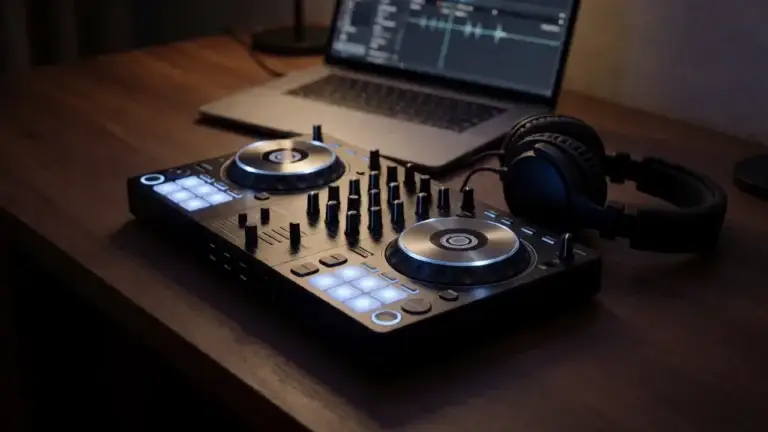
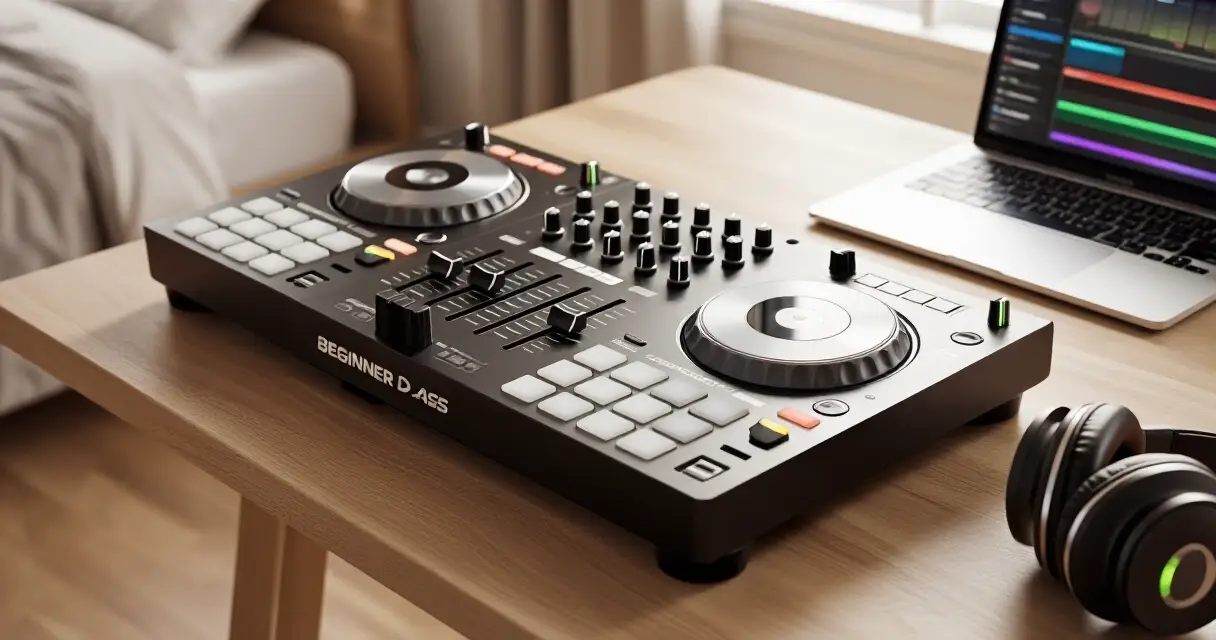
Buying a first DJ controller in 2026 means picking through a market that has genuinely improved at every price point, but where street prices for the most recommended beginner units — the Pioneer DJ DDJ-FLX4 and DDJ-REV1 chief among them — are moving fast on both retailer sale pages and open-box listings. This guide is built around specifications and prices checked against current retailer listings, not marketing copy, so you can see exactly what changes as you move from a $120 pocket controller to a $400 near-pro board, and what the software and accessory costs on top of that hardware actually look like once you add them up.
Direct answer: what’s the best beginner DJ controller in 2026?
For most first-time buyers in the United States, the Pioneer DJ DDJ-FLX4 is the best all-round beginner DJ controller in 2026, with current guides pricing it around $329 at full retail and as low as $279.99 on open-box listings. If your budget is under $150, the Hercules DJControl Inpulse 200 MK3 at roughly $119.99 is the strongest entry point that still includes a real audio interface. The right pick ultimately depends on which DJ software ecosystem — Serato or rekordbox — you plan to grow into, since that choice affects long-term software costs far more than the hardware price does.
Why 2026 is a good year to buy your first DJ controller
DJ gear pricing has settled into fairly predictable tiers this year, and according to current 2026 buying guides, a quality beginner DJ controller now costs between $120 and $350, a range that has stayed consistent across multiple retailer roundups published this month. That stability matters, because it means the sticker price you see on a given model is less likely to be an inflated pre-holiday number and more likely to reflect where that unit will sit for the rest of the year.
At the same time, software has become a bigger part of the total cost of getting started. Serato’s 2026 hardware ecosystem now officially supports 16 manufacturers across more than 200 devices, according to Serato’s own hardware compatibility documentation, spanning Pioneer DJ, AlphaTheta, Rane, Numark, Denon DJ, Reloop, Roland, and Hercules. That breadth is a genuine shift from a few years ago, when Serato compatibility was a real constraint on which controller you could buy. rekordbox, Pioneer DJ’s own software, remains free at its entry tier and scales up through paid plans, while Serato DJ Pro is available as an $11.99/month subscription or a $299 one-time license, per a September 2026 comparison of the two platforms.
How we know: pricing and specification figures in this article come from current 2026 retailer listings and buying guides, cross-checked across multiple independent sources rather than a single manufacturer page. Where a figure could not be independently confirmed, it has been left out rather than estimated.
Best beginner DJ controllers in 2026: quick comparison table
| Controller | Approx. Price (2026) | Best For | Software |
|---|---|---|---|
| Hercules DJControl Inpulse 200 MK3 | $119.99 | Absolute beginners, tightest budget | DJUCED, Serato DJ Lite compatible |
| Pioneer DJ DDJ-REV1 | $299 retail / $264.99 open-box | Scratch-style layout on a budget | Serato DJ Lite / rekordbox |
| Pioneer DJ DDJ-FLX4 | $329 retail / $279.99 open-box | All-round beginner pick | rekordbox / Serato DJ Lite |
| Numark Mixtrack Platinum FX | Falls in the $200–$400 beginner band | Hands-on FX pads and jog wheel feel | Serato DJ, Virtual DJ |
| Hercules Inpulse 500 | Falls in the $200–$400 beginner band | Step-up features while staying beginner-friendly | DJUCED, Serato DJ Lite compatible |
How we know: prices in this table are drawn from current 2026 retailer and deals-page listings, including open-box pricing from ProAudioStar’s active 2026 DJ deals page, and from multiple beginner-DJ buying guides published in the same month as this article. We have not personally bench-tested every unit in this table — where a review guide is cited as the source of a hands-on claim, that is noted explicitly.
Pioneer DJ DDJ-FLX4: the default beginner pick
The DDJ-FLX4 keeps showing up as the top recommendation across independent 2026 guides for a simple reason: it splits the difference between price and features better than almost anything else in its class. One 2026 review guide lists it at $329, while a separate 2026 roundup pegs it at “around $349 / €329” and specifically calls it the best all-round choice for beginners who want room to grow. A third source — ProAudioStar’s active deals listing — shows the DDJ-FLX4 available open-box at $279.99, down from a $329.00 list price, which is worth checking if you’re comfortable with a refurbished or open-box unit to save roughly $50.
What you’re actually paying for
The FLX4’s appeal isn’t a single standout spec — it’s that it doesn’t force an early trade-off. It works with both rekordbox and Serato DJ Lite, so you aren’t locked into one ecosystem before you’ve even learned to beatmatch. That flexibility is a meaningful hedge against buyer’s remorse: a beginner who starts on the free tier of one platform and later decides to move to the other doesn’t need new hardware to do it. That dual-software support is relatively rare at this price band — many competing controllers ship locked to a single software partner, which can box in a beginner who later discovers a preference for the other ecosystem’s workflow, effects library, or streaming-service integrations.
Where it sits against the REV1
Pioneer DJ’s own DDJ-REV1 undercuts the FLX4 slightly — listed at $299 retail and available open-box at $264.99 per the same ProAudioStar listing — but trades some of that FLX4 flexibility for a scratch-oriented layout modeled more closely on club-style mixers. If your interest leans toward scratching and turntablist-style mixing rather than open-format blending, the REV1’s layout is the more honest starting point, even at a similar price. The scratch-style layout typically means a straight fader arrangement built for quick cuts and a mixer curve tuned for scratch technique, rather than the smoother blending curve found on all-round controllers like the FLX4. Choosing between the two really comes down to which style of DJing you expect to spend most of your practice time on, since retrofitting either layout to a different style of play is possible but rarely comfortable.
Budget pick: Hercules DJControl Inpulse 200 MK3
At $119.99, the Hercules DJControl Inpulse 200 MK3 is cited by a current 2026 review guide as one of the two strongest current starter controllers, alongside the DDJ-FLX4. The key distinction most buyers miss at this price tier is the built-in audio interface: several 2026 buying guides note that below roughly $150, controllers commonly start dropping the dedicated audio interface that lets you monitor a cued track through headphones while the crowd (or your bedroom) hears something different. The Inpulse 200 MK3 retains that feature, which is the difference between practicing seriously and just clicking through a demo mode.
The Inpulse 200 MK3 also ships with Hercules’s own DJUCED software and is compatible with Serato DJ Lite, giving beginners on the tightest budget a genuine entry point into the same broader software ecosystem used by pricier controllers. That matters because it means a beginner who starts here isn’t stuck outside the Serato hardware catalog referenced earlier — if the hobby sticks, upgrading later to a Serato-certified controller from any of Serato’s 16 supported manufacturers keeps your learned workflow and any purchased Serato license intact.
How much should you actually budget for a first DJ setup?
Controller price alone doesn’t tell the full story. A current 2026 cost breakdown from an independent DJ equipment guide lays out a full beginner setup — controller, headphones, and software — at $500 to $900 total, built around a Pioneer DDJ-FLX4 at roughly $280 plus Audio-Technica ATH-M50x or Sony MDR-7506 headphones at $100–$150, with speakers or a PA system not included in that figure. That’s a useful reality check: the controller is typically 30–40% of what a genuinely usable first rig costs once headphones and software licensing are factored in.
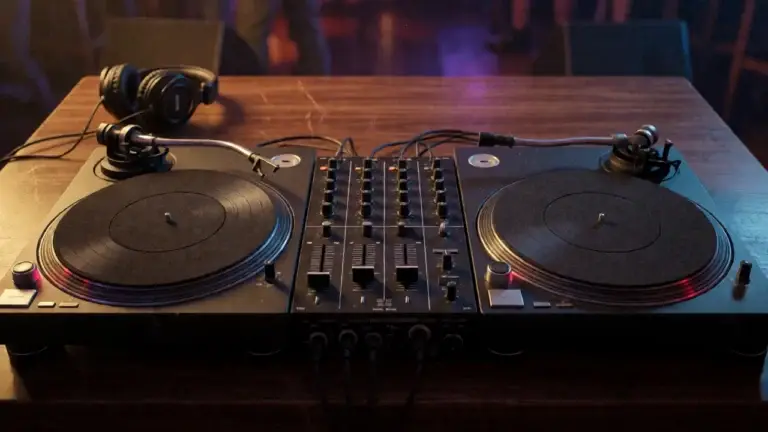
A separate 2026 DJ equipment cost guide breaks the category down by component, listing controllers in a low-to-high range of $100 to $1,000+, with most beginner and intermediate buyers landing in the $350–$500 band. That same guide notes turntables for DJ use span $150 at the low end up to $2,000+ for professional analog or digital-ready decks — a useful contrast if you’re deciding between a controller-based setup and a more traditional turntable-and-mixer approach. For anyone weighing that fork in the road, it’s worth remembering that a turntable-and-mixer setup also typically requires standalone media players or laptops running separate DJ software, which adds cost and complexity a single all-in-one controller avoids entirely.
Budget tier breakdown: what changes at each price point
| Budget Tier | Price Range | Best For | Typical Software | Example Models |
|---|---|---|---|---|
| Entry | Under $200 | First-time learners | Serato DJ Lite, Virtual DJ LE | Numark DJ2GO2, DDJ-200 |
| Beginner | $200–$400 | Serious hobbyists | Serato DJ Lite, rekordbox | DDJ-FLX4, Mixtrack Pro FX |
| Step-up | $400–$1,000+ | Gigging-ready features | Serato DJ Pro, rekordbox | DDJ-REV5, DDJ-FLX10 |
How we know: this tier breakdown is drawn from a current 2026 DJ gear resource hub that organizes controllers by budget tier and lists representative models per tier, cross-referenced against the open-box pricing on ProAudioStar’s active deals page, where the Pioneer DJ DDJ-REV5 is listed at $939.99 (down from $1,189.00) and the DDJ-FLX10 at $1,379.99 (down from $1,729.00) — both confirming that the step-up tier does run well past $1,000 at full retail.
The gap between the beginner and step-up tiers is not just about extra pads or flashier lighting. Controllers in the $400–$1,000+ range typically add standalone playback capability, larger and higher-resolution jog wheel displays, four-channel mixing instead of two, and dedicated hardware effects units rather than software-only effects. None of those are essential for learning the fundamentals — beatmatching, phrasing, and basic transitions are just as learnable on a $150 controller as a $1,700 one — but they become relevant once you’re playing in front of a crowd and need the reliability of standalone operation or the flexibility of four-deck mixing.
Serato vs. rekordbox: the software decision that outlasts your hardware
Software is the part of a beginner DJ purchase that’s easiest to underweight, and it’s also the part with the widest cost spread. A September 2026 comparison of the two dominant platforms lays out the numbers plainly: rekordbox offers a free tier plus paid plans at $12, $18, or $36 per month, while Serato DJ Pro is $11.99/month or a one-time license at $299. Run out over three years, a Serato DJ Pro one-time purchase totals $299 versus $0 for rekordbox’s free tier or Serato DJ Lite — a gap that can exceed the price of the controller itself.
The practical takeaway: if you’re not sure you’ll stick with DJing past the first few months, start on whichever free tier ships with your controller — rekordbox or Serato DJ Lite — before paying for a Pro license. Both the DDJ-FLX4 and DDJ-REV1 support this free-tier-first approach, which is part of why they’re recommended so consistently for beginners.
Beyond price, the two ecosystems differ in how they handle streaming integration and library management, though the specifics of each platform’s current streaming partnerships change often enough that it’s worth checking each software’s own site before committing, rather than relying on older comparisons. What stays constant is the hardware-lock-in question: because Serato now certifies hardware from 16 manufacturers and more than 200 devices, starting on Serato DJ Lite with a beginner controller does not meaningfully limit which controller you can upgrade to later. rekordbox’s hardware support is more concentrated around Pioneer DJ and AlphaTheta gear, which is worth knowing if you anticipate wanting non-Pioneer hardware down the line.
Headphones: the accessory beginners underspend on
DJ headphones don’t get the same attention as controllers, but they matter more than most beginners expect, because cueing the next track accurately depends on being able to isolate it from the room. A current 2026 headphones-for-vinyl guide notes that many turntables and controllers don’t offer a headphone output on the deck itself, meaning you’ll often need either a separate amplifier or a dedicated headphone amp to monitor cleanly — a wiring detail worth checking before you buy if your setup doesn’t route through a full mixer. Controllers with a built-in audio interface, including every model recommended in this guide, avoid that problem by providing a dedicated headphone cue output directly on the unit.
Among current listings, Pioneer DJ’s own HDJ-X5-K is available open-box at $109.99, down from $119.00, according to the same ProAudioStar 2026 deals page — a reasonable match for a DDJ-FLX4 or DDJ-REV1 setup without adding much to the total budget. Wirecutter’s current beginner setup guide separately points to the Sony MDR-7506 as a widely trusted option among both audiophiles and DJs, citing its reliability and comfort relative to price. Whichever pair you choose, the two attributes that matter most for cueing are strong passive isolation (so you can hear the cued track over ambient room noise without cranking the volume dangerously loud) and a coiled or detachable cable that can survive being tugged during quick beatmatching adjustments.
Mixers: do you need one if you already have a controller?
For most beginners, no — a standalone controller like the DDJ-FLX4 already includes its own two- or four-channel mixer section, which is precisely why it’s the recommended starting point rather than buying a turntable-and-mixer setup separately. That said, if you already own turntables or plan to add a second pair of decks later, a compact mixer becomes relevant. Pioneer DJ’s DJM-250MK2 is currently listed open-box at $349.99, down from $419.00, per the ProAudioStar deals page — useful context if you’re pricing out a hybrid setup rather than a pure controller.
A hybrid setup — turntables or CDJs feeding into a standalone mixer — generally costs more than an all-in-one controller once you add up each component, but it offers a different kind of upgrade path: individual pieces (the mixer, the decks, the cartridges) can be swapped out independently as your needs change, rather than replacing an entire controller at once. For a true beginner focused on learning the fundamentals rather than assembling a permanent club-style rig, that flexibility usually isn’t worth the added cost and complexity.
Matching a controller to how you actually plan to use it
Not every beginner has the same goal, and the “best” controller changes depending on what you’re optimizing for:
- Casual bedroom practice — the Hercules DJControl Inpulse 200 MK3 at $119.99 covers the essentials without overspending on features you may not use for months.
- Serious hobbyist aiming to eventually play out — the Pioneer DJ DDJ-FLX4 at $329 (or $279.99 open-box) gives the most headroom for growth, since its dual-software support and mainstream layout carry over cleanly to house parties and small gigs.
- Scratch-focused or turntablist-leaning beginners — the Pioneer DJ DDJ-REV1 at $299 (or $264.99 open-box) better matches the fader and layout conventions used in scratch-style mixing.
- Performance-pad-heavy, trigger-based styles — the Numark Mixtrack Platinum FX, priced within the general $200–$400 beginner band, emphasizes larger pads suited to sample-triggering and live remix-style performance.
- Buyers who expect to outgrow “beginner” gear within a year — the Hercules Inpulse 500, also in the $200–$400 band, offers a feature set positioned as a step above pure entry-level units while remaining approachable.
What actually matters when comparing beginner controllers
Strip away the marketing language and a handful of factors consistently separate a good beginner purchase from a frustrating one, according to multiple current 2026 buying guides:
- Built-in audio interface — lets you cue privately in headphones while the main mix plays elsewhere; commonly missing below roughly $150.
- Software compatibility — check whether the controller ships with a free tier of Serato DJ Lite or rekordbox, since that avoids an immediate software cost on top of the hardware.
- Jog wheel size and feel — smaller jog wheels on sub-$150 units make precise scratching and nudging noticeably harder to learn on.
- Pad and FX layout — controllers like the Numark Mixtrack Platinum FX emphasize larger performance pads, which matters if you’re interested in trigger-based performance over straight mixing.
- Upgrade path — a controller that works with the same software ecosystem as higher-end gear (Serato’s 200+ device catalog, for instance) lets you upgrade hardware later without relearning software.
- Open-box and refurbished availability — the price gaps documented above (roughly $50 on the FLX4, $34 on the REV1, $69 on the HDJ-X5-K headphones) show that checking refurbished listings before buying new can meaningfully change the total cost of a first setup.
Common mistakes first-time DJ controller buyers make
A few patterns show up repeatedly in 2026 buying advice, and they’re worth calling out directly:
- Buying the cheapest possible controller without checking for a built-in audio interface, then discovering you can’t cue privately.
- Paying for a Serato DJ Pro license before confirming you’ll stick with the hobby, when a free tier would have covered the first several months.
- Ignoring open-box and refurbished listings, which on models like the DDJ-FLX4 and DDJ-REV1 can represent meaningful savings — roughly $50 and $34 respectively on the ProAudioStar listings referenced above — with the same manufacturer warranty terms typically still applying.
- Underbudgeting for headphones, then using earbuds that can’t isolate the cued track from room noise.
- Assuming a scratch-style layout and an all-round layout are interchangeable, then finding the fader curve or channel layout doesn’t suit the style of mixing they actually want to practice.
- Jumping straight to a $1,000+ step-up controller before confirming, on cheaper gear, that the fundamentals of beatmatching and transitions are enjoyable enough to justify the extra spend.
Limitations of this guide
This guide is built from current 2026 retailer listings, deals pages, and independent buying guides rather than hands-on bench testing performed by this publication. Open-box and sale pricing changes frequently and may not match the price you see at checkout; treat every price cited here as a snapshot from September 2026 rather than a guaranteed current figure. We have also not covered standalone DJ systems (all-in-one units with built-in screens) or professional club-standard gear like the Pioneer DJ CDJ line, since those sit outside the beginner budget range this guide focuses on. Software pricing, especially subscription tiers, is also subject to change more frequently than hardware pricing, so confirm current rates directly with Serato or AlphaTheta/Pioneer DJ before budgeting a multi-year total.
The bottom line for 2026 buyers
If you want the single safest beginner purchase in 2026, the Pioneer DJ DDJ-FLX4 remains the most consistently recommended option across independent guides, striking a balance between price, software flexibility, and room to grow. If your budget is tighter, the Hercules DJControl Inpulse 200 MK3 is the lowest-price option that still includes a real audio interface, which matters more than almost any other spec at the entry level. Whichever controller you choose, budget separately for headphones and be deliberate about whether you actually need a paid software license before you’ve confirmed you’ll stick with DJing past the first few months — those two decisions, more than the controller model itself, determine whether your first setup costs $500 or $900. Check open-box listings before paying full retail: on the models covered here, that single step can save anywhere from $34 to over $300, without giving up the manufacturer’s standard warranty coverage.
Related Reading
- Best Turntable for Beginners: What to Buy in 2026 (and What to Avoid)
- Best Record Player with Speakers: All-in-One vs Separates (2026)
- Best Home Stereo System for Music: Three Routes and What They Cost
- Sony WH-1000XM4C vs AirPods 5: The 2026 ANC Headphone Buying Guide
- Best Turntable Under $500: What the Extra Money Buys (2026)
- Best Phono Preamps for 2026: Spec-Led Picks From $99 to $499
Sources: Serato DJ hardware compatibility documentation; ProAudioStar 2026 DJ/Live Sound deals listings; DJ Tech Reviews Best Beginner DJ Controllers 2026; DJ.Studio Best DJ Controllers for 2026; FinForum 8 Best DJ Controllers (September 2026); DJ Will Gill’s 2026 DJ Equipment Cost Guide; Digital DJ Pool’s Serato vs Rekordbox 2026 comparison; LatestCost DJ Equipment Cost Price Ranges 2026; Offbeat Inc. DJ Gear Hub 2026; Loudersound Best Headphones for Vinyl 2026; NYT Wirecutter Best Record Player Setup for Beginners.