Summary
The best active speakers have the amplifier inside the cabinet. That single design decision removes most of the difficulty from building a stereo system, and it introduces one real drawback nobody mentions in the marketing. This guide covers what active...
Table of Contents
- 1 The short answer
- 2 Active, powered, passive — the terms
- 3 The best active speakers by budget
- 3.1 Edifier R1280DB — the default under $200
- 3.2 Kanto YU4 — the one to save for
- 3.3 Audioengine A2+ — for a desk
- 4 The drawback worth understanding
- 5 Common questions
- 5.1 Do active speakers sound better than passive?
- 5.2 Can I connect a turntable directly?
- 5.3 Why is only one speaker heavy?
- 5.4 Are studio monitors the same thing?
- 6 Where to start
The best active speakers have the amplifier inside the cabinet. That single design decision removes most of the difficulty from building a stereo system, and it introduces one real drawback nobody mentions in the marketing.
This guide covers what active speakers do better, what they do worse, and which pairs are worth buying in 2026 at each price.
The short answer
- Best under $200: Edifier R1280DB — phono stage included, so a turntable plugs straight in.
- Best around $350: Kanto YU4 — 70 watts, real bass, and the pair most turntable shops recommend.
- Best for a desk: Audioengine A2+ — small enough to sit either side of a monitor and still sound like hi-fi.
- Worth knowing: when the internal amplifier fails, the speaker is finished. Passive speakers outlive their amplifiers.
Active, powered, passive — the terms
These get used interchangeably and they are not the same thing.
| Type | Amplifier | Crossover | Needs |
|---|---|---|---|
| Passive | External | Passive, after the amp | An amplifier |
| Powered | One amp inside | Passive | A source only |
| Active | One amp per driver | Active, before the amps | A source only |
Truly active designs put a separate amplifier on each driver and split the frequencies before amplification, which is measurably more efficient and allows precise correction. Most consumer “active” speakers are really powered — one amplifier, passive crossover. The distinction matters at the high end and rarely below $500.
The best active speakers by budget
| Model | Approx. price | Power | Phono input | Best for |
|---|---|---|---|---|
| Edifier R1280DB | $160 | 42 W | Yes | Turntables on a budget |
| Audioengine A2+ | $270 | 60 W | No | Desks and small rooms |
| Kanto YU4 | $300 | 70 W | Yes | Living rooms |
| Edifier S3000 Pro | $600 | 265 W | No | Going loud without separates |
| KEF LSX II LT | $1,200 | 200 W | No | Genuinely active, streaming built in |
Edifier R1280DB — the default under $200
Around $160, and the built-in phono stage is the reason it keeps appearing in turntable guides. Connect a turntable directly, no preamp, no extra box. Optical and coaxial inputs mean it doubles as a television speaker.
The limits are honest ones: 4-inch drivers do not move much air, so bass rolls off early and it will not fill a large room. In a bedroom or study it is remarkable value.
Kanto YU4 — the one to save for
Around $300. Turntable Lab describes the YU4 as hitting the sweet spot of size, power and features, and that is a fair summary — 70 watts, a phono stage, tone controls and aptX Bluetooth.
The 5.25-inch woofers make the difference. Compared with the Edifiers, bass has weight rather than merely presence, and the extra power means it stays composed at volume — our guide to speakers for bass and sound quality explains why driver size decides this.
Audioengine A2+ — for a desk
Around $270 and physically tiny, which is the point. On a desk, a metre from your head, they sound considerably better than their size suggests. In a living room they run out of capability quickly.
The drawback worth understanding
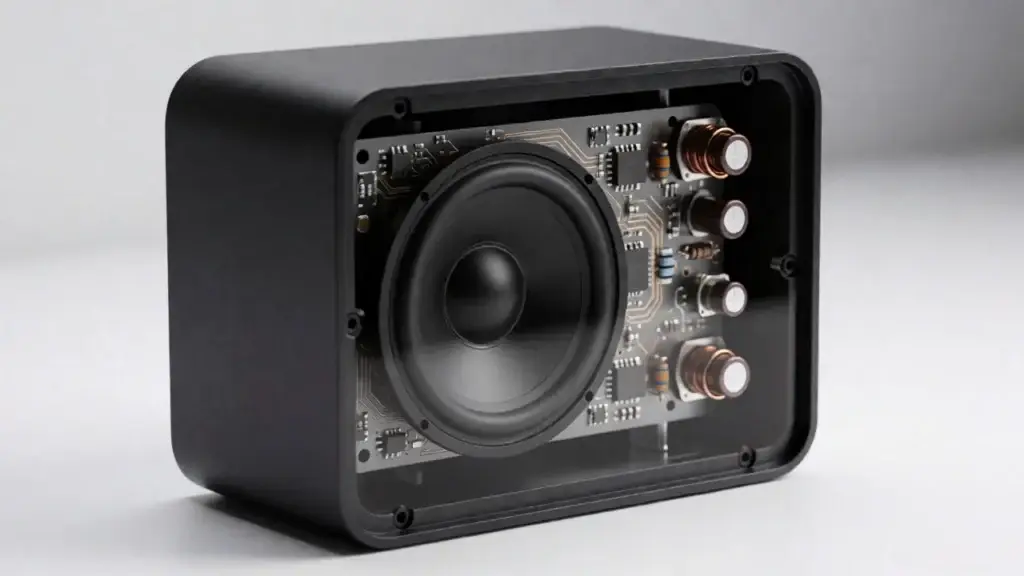
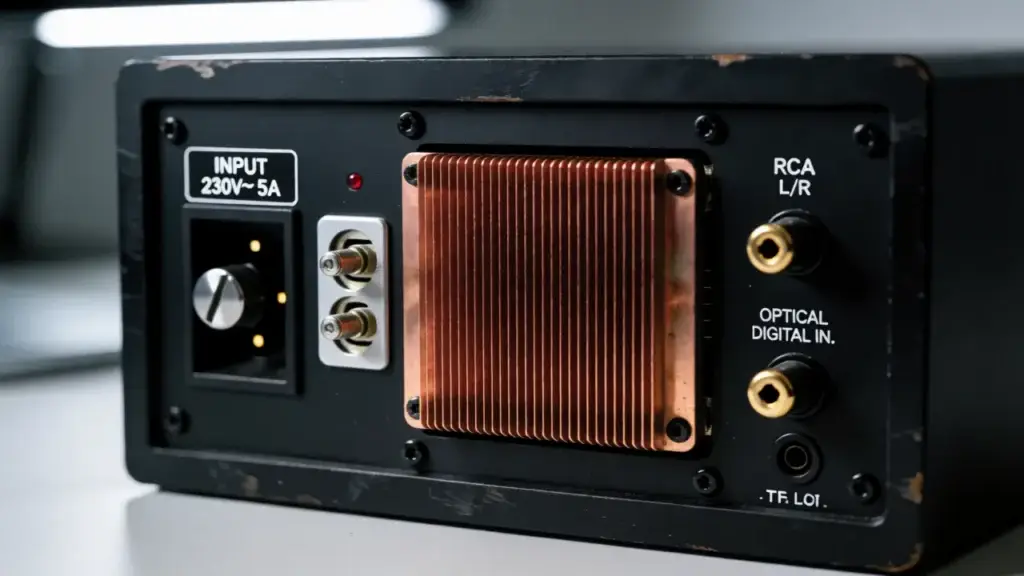
An active speaker is a speaker and an amplifier in one disposable unit. When the amplifier board fails — and electronics fail sooner than drivers — the speaker becomes scrap, because a replacement board usually costs more than the speaker did.
Passive speakers separate those lifespans. Working 1980s speakers are common; working 1980s active speakers are not. If you expect to keep a system for twenty years, that is a genuine argument for separates — and for budget floorstanders if the room is large enough to justify them.
The counter-argument is equally fair: most people do not keep speakers for twenty years, and a matched active pair at $300 beats an unmatched amplifier-and-speaker combination at the same price. Both things are true.
Common questions
Do active speakers sound better than passive?
Below about $500, usually yes, because the manufacturer matched the amplifier to the drivers. Above that, well-chosen separates pull ahead, mostly because you can spend disproportionately on the speakers.
Can I connect a turntable directly?
Only if one of them has a phono stage — the speakers or the turntable. The Edifier R1280DB and Kanto YU4 both do; the Audioengine A2+ does not. Check before ordering, since this is the most common post-purchase surprise. Our turntable and speaker packages guide lists pairings where this is already resolved.
Why is only one speaker heavy?
The amplifier lives in one cabinet and feeds the other through a cable. That is normal, and it means the powered one should go nearest the mains socket.
Are studio monitors the same thing?
Mechanically similar, tuned differently. Monitors aim for flat and unflattering, which is what mixing requires. For listening, most people prefer the gentler tuning of consumer active speakers.
Prices checked 27 July 2026 and shown in USD. Street prices move often — treat them as a guide, not a quote.
Where to start
Under $200 with a turntable: Edifier R1280DB. Around $300 in a real room: Kanto YU4. On a desk: Audioengine A2+.
Weighing this against separates? Our home stereo system guide compares both routes, and the record player with speakers guide covers turntable pairings.