Summary
✓Reviewed by David ChenChoosing an AV receiver in late 2026 means picking between a wave of freshly announced models from Yamaha, Denon, and Arcam, each targeting a different budget and channel count. This guide compares current-generation receivers by price, channel...
Table of Contents
- 1 Direct Answer: Which AV Receiver Should You Buy in 2026?
- 2 2026 AV Receiver Lineup at a Glance
- 3 Yamaha’s Two-Step Refresh: RX300A and RX500A
- 3.1 Who the RX300A Fits
- 3.2 Who the RX500A Fits
- 4 Denon’s Current Lineup: AVR-S980H, AVR-X2900H, and AVR-X3900H
- 5 Arcam Radia AV: A New Premium Tier
- 6 Room Correction: Audyssey vs. Dirac Live ART
- 7 Matching Channel Count to Your Room
- 8 Price-to-Channel Value Breakdown
- 9 How This Fits With Marantz and Other Home Theater Gear
- 10 Soundbars as a Lower-Commitment Alternative
- 11 What This Comparison Does Not Cover
- 12 Headphones and Turntables in the Same Ecosystem
- 13 Wireless and Multi-Room Alternatives
- 14 Buying Recommendations by Budget
- 15 Looking Ahead: What to Watch in Late 2026
- 15.1 Related Reading / See Also
- 15.2 Sources
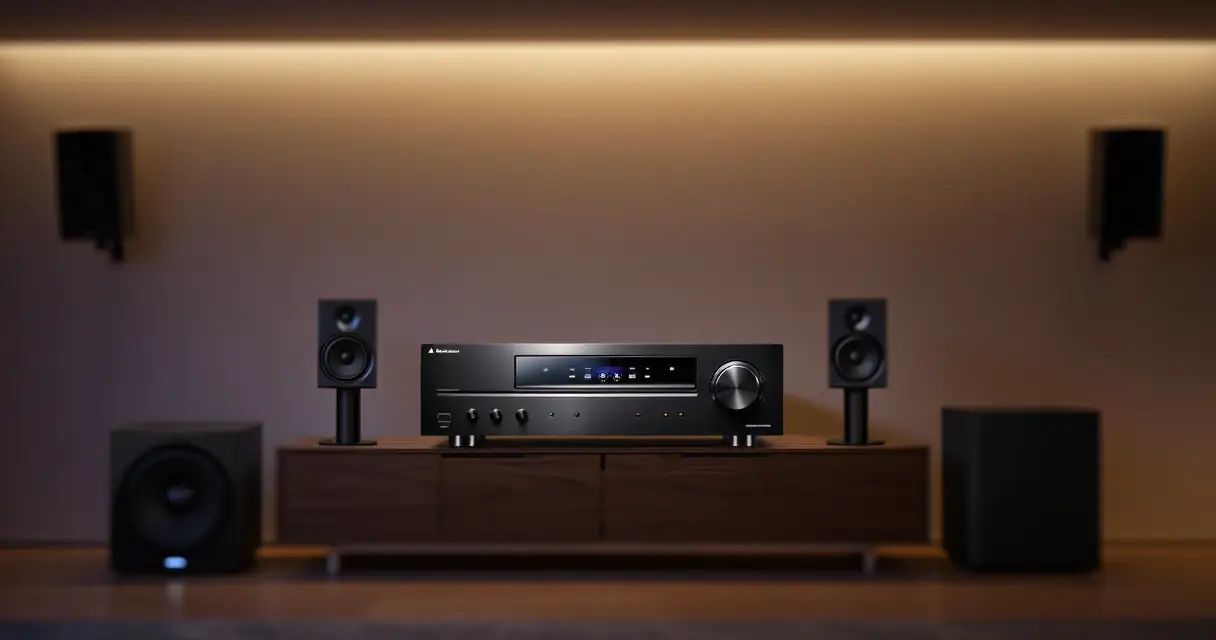
Choosing an AV receiver in late 2026 means picking between a wave of freshly announced models from Yamaha, Denon, and Arcam, each targeting a different budget and channel count. This guide compares current-generation receivers by price, channel count, and processing features using verified specifications, so you can match a model to your room without paying for headroom you will never use.
Direct Answer: Which AV Receiver Should You Buy in 2026?
For most living rooms, the Yamaha RX500A ($600, 7-channel, announced for September 2026) is the strongest value in the current AV receiver lineup, undercutting Denon’s comparable AVR-X2900H ($1,350) by more than half while still offering seven channels of amplification. Budget shoppers should look at the Yamaha RX300A ($399.95, 5-channel, June 2026), while anyone building a reference-grade home theater with room correction should consider the Denon AVR-X3900H ($1,850, 9-channel) or step up further into Arcam’s new Radia AV range, which starts at $3,000. The right choice depends on channel count, whether you need advanced Audyssey room correction, and how much you are willing to spend on amplification versus speakers.
2026 AV Receiver Lineup at a Glance
As of September 29, 2026, the AV receiver market has split into three clear tiers: entry-level five- and seven-channel models under $1,000, mainstream X-Series and S-Series receivers in the $950 to $1,850 range, and a new premium tier from Arcam starting at $3,000. The table below summarizes the current-generation models with confirmed pricing and specifications.
| Model | Channels | Price (USD) | Announced | Notes |
|---|---|---|---|---|
| Yamaha RX300A | 5 | $399.95 | June 2026 | Entry-level home theater receiver |
| Yamaha RX500A | 7 | $600 | September 2026 | Higher-channel step-up from RX300A |
| Denon AVR-S980H | 7 | $950 | Current | Uses a less advanced Audyssey tier than X-Series |
| Denon AVR-X2900H | 7 | $1,350 | Current | Mainstream X-Series model |
| Denon AVR-X3900H | 9 | $1,850 | Current | Successor to the prior X-Series upgrade pick |
| Arcam Radia AVA15 | — | $3,000 | Current | Entry point to Arcam’s new Radia AV range |
| Arcam Radia AVA25 | — | $5,000 | Current | Adds Dirac Live ART room correction |
| Arcam Radia AVA35 | — | $7,000 | Current | Flagship, Class D/AB/G amplification |
How we know: pricing and channel counts for the Yamaha RX300A, RX500A, and the Denon AVR-S980H, AVR-X2900H, and AVR-X3900H come from current 2026 receiver buying-guide listings and Yamaha’s own announced MSRP for the RX300A. Arcam Radia pricing and feature details come from Arcam’s Radia AV range announcement.
Yamaha’s Two-Step Refresh: RX300A and RX500A
Yamaha revised its budget and mid-tier receiver lineup in two stages this year. The RX300A launched first, in June 2026, as a five-channel home theater receiver with a U.S. manufacturer’s suggested retail price of $399.95, positioning it as the current entry-level pick in Yamaha’s home theater range. Three months later, Yamaha followed with the RX500A, a seven-channel receiver priced at $600 and announced for September 2026 availability. The RX500A effectively replaces older, lower-feature Yamaha budget models in current buying guides, giving shoppers two extra channels of amplification for a $200 premium over the RX300A.
Who the RX300A Fits
At $399.95, the RX300A is aimed at buyers building a first 5.1-channel home theater setup — a soundbar upgrade path rather than a full Dolby Atmos install. Five channels of amplification cover front left, right, and center, plus a stereo surround pair, which is enough for most apartment or bedroom home theater builds where a subwoofer handles low end separately. If your room does not need height channels for Dolby Atmos or DTS:X immersive audio, the RX300A avoids paying for amplifier channels you will not use.
Who the RX500A Fits
The RX500A’s seven channels open the door to a 5.1.2 or 7.1 configuration, which matters if you are pairing the receiver with height or in-ceiling speakers for object-based surround formats. At $600, it remains well below the Denon AVR-S980H’s $950 price point while matching that model’s seven-channel count, making it the more aggressive value pick for buyers who do not need Denon’s Audyssey room correction tier.
Denon’s Current Lineup: AVR-S980H, AVR-X2900H, and AVR-X3900H
Denon’s 2026 receiver range spans three current models that sit above Yamaha’s budget tier. The AVR-S980H is priced at $950 and offers seven channels, but current buying guides note it uses a less advanced version of Audyssey room correction than Denon’s X-Series models — a meaningful trade-off if precise room correction matters for your speaker placement. Moving up, the AVR-X2900H is a seven-channel X-Series model priced at $1,350, and the AVR-X3900H is a nine-channel model priced at $1,850 that is explicitly described in current market coverage as the successor to the prior X-Series upgrade pick.
The jump from the AVR-S980H to the AVR-X2900H costs $400 for the same channel count, which only makes sense if the more advanced Audyssey tier is a priority for your listening room. The further jump to the nine-channel AVR-X3900H adds $500 and two extra channels, useful for a full 5.1.4 Dolby Atmos configuration with four height or up-firing speakers.
Arcam Radia AV: A New Premium Tier
Arcam’s Radia AV range introduces three new receivers — the AVA15 at $3,000, the AVA25 at $5,000, and the AVA35 at $7,000 — positioning the brand well above the Yamaha and Denon models covered so far. All three models in the range add Dirac Live ART room correction, a more advanced alternative to Audyssey, and use a mix of Class D, Class AB, and Class G amplification depending on the model. This range targets buyers who have already invested in higher-end speakers and want amplification and room correction to match, rather than shoppers comparing on channel count and price alone.
Room Correction: Audyssey vs. Dirac Live ART
Room correction software measures how your speakers interact with your room’s walls, furniture, and reflective surfaces, then applies digital correction to flatten the frequency response at your listening position. This is one of the most consequential — and least understood — specifications on a receiver’s spec sheet, because two receivers with identical channel counts can sound meaningfully different once room correction is applied.
- Denon AVR-S980H: ships with a less advanced Audyssey tier than Denon’s X-Series receivers, according to current 2026 buying guides.
- Denon AVR-X2900H and AVR-X3900H: use Denon’s more advanced X-Series Audyssey implementation.
- Arcam Radia AVA25 and AVA35: add Dirac Live ART, a room correction system positioned above standard Audyssey tiers in current Arcam marketing.
If your listening room has hard floors, large windows, or an open floor plan, prioritizing the more advanced room correction tier is likely to matter more than an extra one or two amplifier channels.
Matching Channel Count to Your Room
Channel count determines how many discrete speakers a receiver can power, and it is the single biggest factor separating the models in this comparison. Here is how the current lineup breaks down by use case.
| Configuration | Channels Needed | Matching Current Models |
|---|---|---|
| Stereo + soundbar-style front array | 5 | Yamaha RX300A |
| 5.1.2 or 7.1 with height or surround back | 7 | Yamaha RX500A, Denon AVR-S980H, Denon AVR-X2900H |
| 5.1.4 full Dolby Atmos with four height speakers | 9 | Denon AVR-X3900H |
| Reference-tier multi-zone or high-power builds | Varies by model | Arcam Radia AVA15 / AVA25 / AVA35 |
Buying more channels than your room needs simply pays for amplifier stages you will never drive. If you are unsure whether you will add height speakers later, the seven-channel tier — Yamaha RX500A, Denon AVR-S980H, or AVR-X2900H — offers the most flexibility without committing to Arcam’s premium pricing.
Price-to-Channel Value Breakdown
Comparing price per channel is a useful, if imperfect, way to see where the value gaps sit in the current lineup. It does not account for room correction quality, power output per channel, or build quality, but it highlights which models are priced aggressively for their channel count.
- Yamaha RX300A: $399.95 for 5 channels ≈ $80 per channel
- Yamaha RX500A: $600 for 7 channels ≈ $86 per channel
- Denon AVR-S980H: $950 for 7 channels ≈ $136 per channel
- Denon AVR-X2900H: $1,350 for 7 channels ≈ $193 per channel
- Denon AVR-X3900H: $1,850 for 9 channels ≈ $206 per channel
Yamaha’s two current models are the clear value leaders on a pure price-per-channel basis. Denon’s premium comes from its more advanced Audyssey room correction tier on the X-Series models and, for the AVR-X3900H, two additional channels for a full Atmos height array — costs that are justified only if those specific features matter for your setup.
How This Fits With Marantz and Other Home Theater Gear
Receivers do not exist in isolation — most buyers are also weighing them against integrated amplifiers for stereo-only listening, or Marantz’s competing CINEMA and Cinema Series 2 lineups for similar price brackets. If you are deciding between a dedicated AV receiver and a two-channel integrated amplifier because your priority is music rather than home theater, our comparison of Marantz, Naim, and Cambridge integrated amplifiers covers that trade-off in detail. For buyers specifically comparing Denon’s X-Series against Marantz’s equivalent tier, see our breakdown of the Marantz Cinema Series 2 lineup across the 50, 60, and 70s models, and our full Marantz CINEMA 70s Series 2 review for a single-model deep dive at a similar price point to the Denon AVR-X2900H.
Soundbars as a Lower-Commitment Alternative
Not every home theater needs a multi-channel receiver and a full speaker array. If your room cannot accommodate rear surround or height speakers, a Dolby Atmos soundbar remains a simpler path to immersive audio without the wiring or amplifier-matching decisions this guide covers. Our guide to the best Dolby Atmos soundbars of 2026 walks through subwoofer pairing and surround kit options for that lower-commitment route.
What This Comparison Does Not Cover
Limitations: this comparison is built from published pricing, channel counts, and feature listings rather than in-room listening tests or measured power output at clipping. We have not independently measured per-channel wattage, HDMI 2.1 bandwidth handling, or real-world Dirac Live ART versus Audyssey performance for these specific models. Buyers making a final decision should confirm current pricing with retailers, since receiver pricing shifts with promotions, and should check full HDMI and streaming platform specifications against their exact source devices before purchasing.
Headphones and Turntables in the Same Ecosystem
A receiver is usually one piece of a broader home audio setup. On the headphone side, Philips has announced the Fidelio L5, a new over-ear wireless model due in October 2026 at a stated European price of €199.99 / £179.99 — worth watching if you also want a personal-listening option alongside your receiver-driven speaker system. On the turntable side, current U.S. retail listings show active pricing across multiple tiers: the Rega Planar 3 RS Edition at $1,125, the Pro-Ject Debut Evo 2 at $799, the Rega Planar 1 Plus at $725, the Audio-Technica AT-LP70XBT at $299, the AT-LP120XUSB at $399, and DJ-oriented decks like the Pioneer DJ PLX-1000 at $889 and PLX-CRSS12 at $1,599. If vinyl playback is part of your setup, any receiver with a dedicated phono input — or an outboard phono preamp — will let you route a turntable through the same amplification chain covered in this guide. For a broader look at building a complete listening system, see our guide to the best home stereo system for music.
Wireless and Multi-Room Alternatives
If running speaker wire throughout a room is not practical, wireless multi-room systems remain a valid alternative to a traditional receiver-and-speaker setup, particularly for secondary rooms rather than a primary home theater. Our comparison of Sonos Ace Ultra versus Beam Ultra covers that wireless-first approach, and for portable listening outside the home theater room entirely, our guide to the best portable Bluetooth speakers of 2026 covers the JBL Xtreme 5 and similar current models.
Buying Recommendations by Budget
Based on the current confirmed pricing and specifications above, here is how we would frame the decision by budget tier.
- Under $500: Yamaha RX300A ($399.95) for a straightforward 5.1 setup without height channels.
- $500–$1,000: Yamaha RX500A ($600) for the best price-per-channel value at seven channels, or the Denon AVR-S980H ($950) if you specifically want Denon’s ecosystem despite the lower Audyssey tier.
- $1,000–$2,000: Denon AVR-X2900H ($1,350) for advanced Audyssey room correction at seven channels, or the AVR-X3900H ($1,850) if you need nine channels for a full Atmos height array.
- $3,000 and up: Arcam Radia AVA15, AVA25, or AVA35, depending on whether Dirac Live ART room correction and higher-grade amplification justify the step up from Denon’s X-Series.
Looking Ahead: What to Watch in Late 2026
Three trends are worth tracking as 2026 closes out. First, Yamaha’s two-step refresh pattern — a budget model followed by a higher-channel model three months later — suggests the company may continue iterating on this lineup into 2027 rather than treating the RX300A and RX500A as a static generation. Second, Denon’s positioning of the AVR-X3900H as a direct successor to its prior upgrade pick signals that the X-Series refresh cycle is active, and further updates to the AVR-X2900H’s tier are plausible. Third, Arcam’s entry into a three-model Radia AV range with Dirac Live ART across multiple price points marks a more aggressive premium push than in prior years, which could pressure Denon and Marantz to bring similar room-correction technology further down their own lineups.
For most buyers evaluating AV receivers in the United States as of September 29, 2026, the practical decision comes down to three questions: how many channels does your room actually need, does advanced room correction matter for your specific space, and how much of the price difference between tiers you are willing to pay for headroom you may not use yet. Matching those answers against the confirmed models and pricing above should narrow the field to one or two realistic candidates rather than the full lineup.
Related Reading / See Also
- Best Integrated Amplifiers 2026: Marantz, Naim, Cambridge Compared
- Marantz Cinema Series 2 Lineup: 50 vs 60 vs 70s Compared
- Marantz CINEMA 70s Series 2 Review: Is It Worth $200 More?
- Best Dolby Atmos Soundbars 2026: Subwoofers, Surround Kits & Specs
- Best Home Stereo System for Music: Three Routes and What They Cost
- Sonos Ace Ultra vs Beam Ultra: The Best Wireless Home Audio for 2026
- Best Portable Bluetooth Speakers 2026: JBL Xtreme 5 Guide
Sources
- Yamaha official site — RX300A and RX500A specifications and pricing
- Denon official site — AVR-S980H, AVR-X2900H, and AVR-X3900H specifications
- Arcam official site — Radia AV range (AVA15, AVA25, AVA35) and Dirac Live ART details
- What Hi-Fi — current receiver and turntable buying guide listings
- Philips official site — Fidelio L5 headphone announcement