
Summary
✓Reviewed by David Chen A phono preamp is the single most overlooked upgrade in a vinyl system — and, dollar for dollar, often the one that changes the sound the most. In short: a phono preamp takes the tiny, tilted...
Table of Contents
- 1 What a Phono Preamp Actually Does
- 2 Moving Magnet vs. Moving Coil: Why Cartridge Type Decides Your Preamp
- 2.1 Moving Magnet (MM) Cartridges
- 2.2 Moving Coil (MC) Cartridges
- 3 How Much Should You Spend on a Phono Preamp?
- 4 Built-In vs. External Phono Stages
- 5 Solid-State vs. Tube Phono Preamps
- 6 Gain, Loading, and Other Specs That Actually Matter
- 7 Signs Your Current Phono Stage Is Holding You Back
- 8 Placement and Setup: Where Noise Actually Comes From
- 9 A Practical Buying Checklist
- 10 Common Mistakes When Choosing a Phono Preamp
- 11 Phono Preamps and the Rest of Your System
- 12 Digitizing and Archiving Through a Phono Preamp
- 13 Limitations of This Guide
- 14 Conclusion: Match the Preamp to the Cartridge First, Everything Else Second
- 14.1 Related Reading / See Also
- 14.2 References
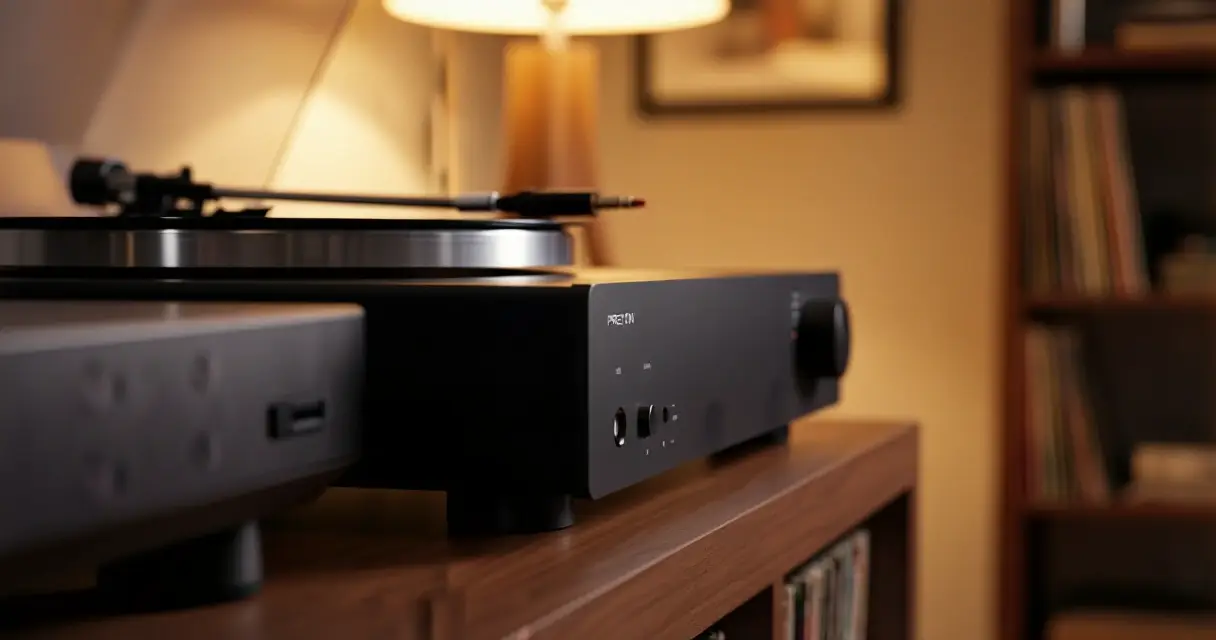
A phono preamp is the single most overlooked upgrade in a vinyl system — and, dollar for dollar, often the one that changes the sound the most. In short: a phono preamp takes the tiny, tilted signal coming off your turntable’s cartridge, boosts it to line level, and applies inverse RIAA equalization so the music arrives at your amplifier balanced instead of thin and hissy. Get the gain and cartridge type matched correctly, and a $50-$100 unit can outperform the preamp built into a budget turntable or receiver. Get it wrong, and even a good cartridge will sound flat, noisy, or too quiet.
As of October 1, 2026, interest in phono preamps is climbing alongside a wave of new turntable launches. Buyers who picked up a new deck this year are realizing that the built-in phono stage, if there is one, is usually the first bottleneck in the chain — a cheap circuit tucked onto the turntable’s main board, built to a price rather than to a standard. This guide breaks down exactly how phono preamps work, what the specifications on the box actually mean, how much to budget, which features matter versus which are marketing noise, and how to set one up correctly — using current 2026 buying-guide data and manufacturer specifications rather than invented numbers.
How we know: the gain, cartridge-output, and pricing figures in this article are drawn from a cross-section of 2026 buying guides and retailer specification sheets, not from in-house bench testing. Where a figure is a range reported by multiple sources, we say so; where we have not tested a unit ourselves, we do not claim hands-on measurements.
What a Phono Preamp Actually Does
Every vinyl record is cut with an equalization curve standardized by the Recording Industry Association of America (RIAA) back in 1954. Bass frequencies are reduced during the cutting process so the groove doesn’t have to swing too wide — wide, bass-heavy grooves would eat up disc space and risk the stylus jumping — and high frequencies are boosted to overcome surface noise and help the signal survive the inherent hiss of a mechanical playback medium. A phono preamp reverses both of those adjustments: it applies the inverse RIAA curve to restore a flat, accurate frequency response, and it amplifies the cartridge’s signal — which is measured in millivolts, far below the line-level signal (roughly 150mV to 2V) that amplifiers and receivers expect — up to a usable level.
Without that correction, a turntable plugged directly into a line-level input (an aux jack, not a dedicated “phono” input) will sound thin, harsh, and extremely quiet, because the signal hasn’t been equalized or boosted. This is why some entry-level amplifiers and all-in-one systems include a dedicated phono input with the preamp stage built in, while others require an external box. It’s also why plugging a turntable into a regular aux input is one of the most common new-owner mistakes — the volume will be barely audible and the tonal balance will sound wrong even when cranked up, because the signal was never meant to be heard unequalized.
Moving Magnet vs. Moving Coil: Why Cartridge Type Decides Your Preamp
The single most important spec to check before buying a phono preamp is which cartridge type it supports. The two main cartridge families — moving magnet (MM) and moving coil (MC) — produce wildly different output levels, and a preamp built for one will not properly serve the other. This is the decision point that determines everything else about the purchase, so it’s worth understanding the underlying mechanics before looking at a single product.
Moving Magnet (MM) Cartridges
MM cartridges are the standard fitment on the overwhelming majority of budget and mid-range turntables sold in 2026, according to multiple current buying guides. In an MM design, tiny magnets are attached to the cantilever and move within fixed coils as the stylus tracks the groove, generating a relatively strong electrical signal. They typically output somewhere in the 3mV to 7mV range and need roughly 35dB to 45dB of gain from a preamp, with 40dB cited repeatedly as the practical target in 2026 buying-guide data. MM preamps are simpler and cheaper to build, which is why most budget and mid-tier phono preamps are MM-only, and why MM cartridges remain the default recommendation for anyone just starting out in vinyl.
Moving Coil (MC) Cartridges
MC cartridges flip the mechanical layout: the coils themselves move within a fixed magnetic field. Because the moving coils are necessarily smaller and lighter than magnets, MC designs can track grooves with lower moving mass, which is part of why they’re associated with higher-end turntables and aftermarket upgrades. The trade-off is output level — MC cartridges put out far less signal, as low as 0.2mV to 0.8mV according to 2026 sourcing, and therefore need substantially more amplification, generally in the 55dB to 70dB range. A preamp that only handles MM gain will leave an MC cartridge sounding whisper-quiet and buried in noise, no matter how good the cartridge itself is. Preamps that support MC typically advertise adjustable gain stages (commonly stepped settings like 38/48dB and 56/66dB) and variable loading so the impedance can be matched to the specific cartridge in use.
Most MM phono preamps use a standard 47k ohm input load, which is the de facto industry standard for moving magnet cartridges and rarely needs adjusting. MC preamps often let you adjust this loading value, since moving coil cartridges can be sensitive to it in ways that audibly change tonal balance — too low a load value can dull high frequencies, while too high a value can make the sound edgy or thin.
Before shopping for a phono preamp, check your turntable or cartridge’s spec sheet (or the box it came in) to confirm whether it’s MM or MC. If you’re not sure, it’s almost certainly MM — multiple 2026 guides note MM cartridges remain the standard fitment on the vast majority of turntables sold today, including most models covered in our beginner turntable guide.
| Spec | Moving Magnet (MM) | Moving Coil (MC) |
|---|---|---|
| Typical output | 3mV – 7mV | 0.2mV – 0.8mV |
| Gain needed | ~35dB – 45dB (commonly ~40dB) | ~55dB – 70dB |
| Standard load | 47k ohm | Often adjustable |
| Turntable fitment | Most budget/mid-range decks | Higher-end decks, upgrade cartridges |
| Preamp cost tier | Entry to mid-range | Mid-range to high-end |
| Typical preamp switchable gain | 38dB / 48dB | 56dB / 66dB |
How Much Should You Spend on a Phono Preamp?
A consistent rule of thumb across current 2026 buying guides is to spend roughly 10% to 20% of your total turntable-and-cartridge budget on the phono preamp. One widely cited guide frames it slightly differently: budget roughly a third to a half of the cartridge’s own price on the preamp feeding it. Either way, the underlying message is the same — the preamp should scale with the rest of the system rather than being bought as an afterthought at either extreme. A $30 preamp feeding a $600 cartridge will bottleneck that cartridge’s resolving power, while a $500 preamp feeding a $40 stock cartridge has nothing meaningful left to reveal.
Based on current 2026 pricing data from multiple buying guides, three practical tiers emerge:
- $50 to $110: Suits stock MM cartridges on budget-to-mid-range turntables. This is also the range where several guides say the jump from a built-in phono stage to any dedicated external unit delivers the most noticeable improvement — the single best dollar-for-dollar upgrade available to a new vinyl listener.
- $150 to $250: Fits upgraded MM cartridges and entry-level MC setups, usually adding adjustable gain and loading options plus better internal shielding against hum.
- $400 and up: Only makes sense once the cartridge, turntable, and speakers downstream are already strong enough to reveal the difference — spending more here before upgrading the rest of the chain is a common buying mistake flagged across 2026 guides.
If you’re assembling a full system rather than a single upgrade, our home stereo system cost breakdown and turntable-under-$500 guide are useful companions for seeing where a phono preamp fits into the overall budget, and in what order to prioritize upgrades as funds allow.
Built-In vs. External Phono Stages
Many budget turntables and some integrated amplifiers include a built-in phono stage, which is convenient but usually represents the cheapest possible implementation a manufacturer can fit without raising the overall price of the unit. Current 2026 guidance is consistent on this point: moving from a built-in phono stage to even a modest $50-$100 dedicated external phono preamp is one of the most cost-effective upgrades in a vinyl system, because a dedicated unit typically uses better components, more careful shielding, and a more precisely tuned RIAA curve than a stage squeezed onto a turntable’s main circuit board alongside the motor control, Bluetooth radio, and power supply.
That said, a built-in stage is not automatically bad — it’s simply a fixed, non-upgradable part of the signal path, and for a casual listener it may be perfectly adequate. If your turntable has a switchable phono/line output (common on many current models, including those covered in our Sony PS-LX3BT vs. AT-LP7X comparison), you can bypass the internal stage entirely and route the raw cartridge signal to an external preamp instead, which also lets you later swap preamps without buying a new turntable.
Solid-State vs. Tube Phono Preamps
Most phono preamps on the market, especially in the budget and mid-range tiers, use solid-state (transistor or op-amp based) circuitry. Solid-state designs are generally quieter, more consistent from unit to unit, and less expensive to manufacture, which is why they dominate the sub-$250 category. A smaller segment of the market offers tube-based (valve) phono preamps, which use vacuum tubes in the gain stage and are associated by enthusiasts with a warmer, softer harmonic character, though this is a matter of listener preference rather than a strictly measurable improvement in accuracy.
Tube preamps typically cost more, both up front and over time, since tubes are a wear item that eventually need replacing, and they run warmer than solid-state equivalents. For a first phono preamp purchase, current 2026 buying guides overwhelmingly point toward solid-state designs for their reliability and value; tube preamps are better suited to listeners who already have a resolved system and are chasing a specific, known sonic character rather than troubleshooting a basic signal chain.
Gain, Loading, and Other Specs That Actually Matter
Phono preamp spec sheets can look intimidating, but a handful of numbers do most of the work:
- Gain (dB): How much the preamp amplifies the incoming signal. Match this to your cartridge type — roughly 40dB for MM, 55-70dB for MC, per current 2026 buying-guide consensus.
- Switchable gain stages: Better units offer stepped gain settings (for example 38/48dB for MM, 56/66dB for MC) so you can fine-tune output level to match your amplifier’s sensitivity rather than being stuck with one fixed level that’s either too hot or too quiet.
- Loading (ohms): The input impedance the preamp presents to the cartridge. 47k ohm is standard for MM; MC preamps often allow adjustable loading because MC cartridges can be more sensitive to this value.
- MM/MC switch: Confirms whether a given unit actually supports both cartridge types, rather than being MM-only with an MC label used loosely in marketing copy.
- Signal-to-noise ratio: Listed on most spec sheets; a higher figure generally indicates a quieter background behind the music, which matters more as system resolution increases.
- Outputs: Most units offer standard RCA line-level outputs; some also include a USB output for digitizing records, which is worth checking if archiving your collection is a goal.
Signs Your Current Phono Stage Is Holding You Back
Not everyone needs to upgrade immediately, but a few symptoms consistently point to a weak or mismatched phono stage rather than a problem with the record, cartridge, or speakers:
- Audible hum or buzz that changes when you touch the tonearm or move cables, often pointing to inadequate shielding or a grounding issue in a budget built-in stage.
- Needing to turn the volume far higher for vinyl than for streaming or CD through the same amplifier, which usually signals insufficient gain for the cartridge in use.
- A thin, bright, or bass-light tonal balance that doesn’t match what the same album sounds like streaming, which can indicate an inaccurate or poorly implemented RIAA curve.
- Distortion or harshness specifically on vinyl that isn’t present on other sources, which can point to gain mismatch overloading the preamp’s input stage.
If any of these apply and you’re currently relying on a turntable’s built-in stage or a receiver’s generic phono input, a dedicated external preamp in the $50-$110 tier is the first and cheapest thing to try before assuming the cartridge or turntable itself is at fault.
Placement and Setup: Where Noise Actually Comes From
Because a phono preamp is amplifying a signal measured in millivolts, it is far more susceptible to picking up hum and interference than any other component in a hi-fi chain. Current 2026 guidance consistently recommends two placement habits:
- Keep the phono preamp physically close to the turntable to minimize the length of unamplified, noise-prone cabling between cartridge and preamp.
- Keep the unit away from power supplies, Wi-Fi routers, and the turntable’s own motor, all of which can induce hum or RF interference into a signal this small.
Beyond placement, a grounding wire (a separate thin wire from the turntable, distinct from the RCA signal cables) is standard on most turntables and should be connected to the preamp’s ground terminal; a loose or missing ground connection is one of the most common causes of persistent hum in an otherwise correctly wired system. If hum persists after confirming the ground connection and relocating the preamp away from obvious interference sources, the next step is testing a different power outlet, since shared circuits with dimmer switches or large appliances can also introduce noise.
If you’re setting up a turntable with built-in speakers or an all-in-one system, note that most of those designs route the signal internally and don’t benefit from (or support) an external phono preamp — see our all-in-one vs. separates comparison for how that trade-off plays out and when separates start to make more sense.
A Practical Buying Checklist
Before buying a phono preamp, current 2026 buying guides converge on the same four questions, repeated across nearly every source reviewed for this piece:
- What cartridge do you have — MM or MC? Check the cartridge or turntable spec sheet. This single answer eliminates most of the shopping list immediately.
- How much gain do you need? Roughly 40dB for MM, 55-70dB for MC; if your amplifier already has some gain of its own, you may be able to use a lower setting.
- Do you want adjustability? Switchable gain and loading let you fine-tune for a specific cartridge or compensate for a quiet amplifier input; fixed-gain units are simpler and usually cheaper.
- What’s your budget tier? $50-$110 for stock MM setups, $150-$250 for upgraded MM/entry MC, $400+ only once the rest of the chain justifies it.
| Budget Tier | Best For | Typical Features |
|---|---|---|
| $50 – $110 | Stock MM cartridges, first upgrade from built-in stage | Fixed or basic switchable gain, 47k ohm MM loading |
| $150 – $250 | Upgraded MM, entry-level MC | Switchable gain stages, adjustable MC loading, better shielding |
| $400+ | Resolved systems with strong cartridge, turntable, and speakers | Premium components, fine-grained gain/loading adjustment, sometimes tube-based |
Common Mistakes When Choosing a Phono Preamp
A few recurring errors show up across 2026 buyer feedback and guide commentary:
- Buying an MM-only preamp for an MC cartridge (or vice versa): the most common and most audible mistake — an MC cartridge run through MM-only gain will sound far too quiet and noisy.
- Running a turntable’s phono output into a preamp AND into an amplifier’s phono input simultaneously: this double-corrects the RIAA curve and distorts the sound; use only one stage of correction at a time.
- Overspending before the rest of the chain is ready: a $400+ preamp will not reveal its advantages through a budget cartridge and entry-level speakers.
- Ignoring placement: even a well-specified preamp will pick up hum if placed near a power brick or router.
- Forgetting the ground wire: a disconnected or missing ground connection is a frequent, easily fixed cause of hum that gets misdiagnosed as a defective unit.
Phono Preamps and the Rest of Your System
A phono preamp doesn’t operate in isolation — it’s one link in a chain that includes the cartridge, turntable, amplifier or receiver, and speakers. If you’re building or upgrading a full system in late 2026, it’s worth sequencing the investment: a strong cartridge and correctly matched preamp will do more for sound quality than an expensive amplifier paired with a mismatched, underpowered phono stage. Our integrated amplifier comparison covers how several current amps handle phono inputs natively, which may reduce or eliminate the need for a separate external preamp depending on which model you choose.
For home-theater-adjacent systems where a receiver handles both AV duties and a turntable, check whether the receiver includes a phono input — many current AV receivers, including several covered in our 2026 AV receiver comparison, do not, which means an external preamp becomes mandatory rather than optional for vinyl playback through that system. This is worth checking before purchase, since discovering it after the fact means an unplanned additional purchase just to get a turntable working at all.
Digitizing and Archiving Through a Phono Preamp
A growing use case in 2026 is using a phono preamp as part of a record-digitizing chain — converting a vinyl collection to digital files for archival or portable listening. Some phono preamps include a built-in USB output specifically for this purpose, bypassing the need for a separate audio interface. If digitizing is a priority, it’s worth confirming the specific preamp offers a USB output before buying, since not all models in the $50-$250 tiers include one, and adding an external USB audio interface afterward is an additional cost and complication that a single combined unit avoids.
Limitations of This Guide
This guide synthesizes gain, loading, and pricing data reported across multiple current 2026 buying guides rather than original bench measurements or listening tests performed by this publication. Individual preamp models, exact gain-stage increments, and specific retailer pricing change frequently and should be confirmed against the current manufacturer spec sheet and live retailer listing before purchase. Readers with especially low-output MC cartridges (below 0.3mV) or unusual tonearm cabling should also consult cartridge-specific loading recommendations, which can vary from the general ranges described here. This guide also does not cover specific named preamp models or head-to-head product rankings, focusing instead on the specifications and decision criteria that apply regardless of which brand or model is ultimately chosen.
Conclusion: Match the Preamp to the Cartridge First, Everything Else Second
The phono preamp decision in 2026 comes down to a short, repeatable sequence: confirm whether your cartridge is MM or MC, match the gain and loading to that cartridge, decide how much adjustability you actually need, and set a budget proportional to the rest of your system — roughly 10% to 20% of your turntable-and-cartridge spend is a reasonable anchor. Most listeners with a stock MM cartridge will get the biggest single improvement by moving from a built-in phono stage to any dedicated $50-$110 external preamp; MC owners and listeners chasing the last increment of detail can look toward the $150-$250 tier and beyond once the rest of the chain supports it. Whatever tier you land in, keep the unit close to the turntable, connect the ground wire, and keep it away from power supplies and routers — the cheapest, most effective noise fix in the entire chain, and one that costs nothing beyond a few minutes of careful setup.
Related Reading / See Also
- Best Turntable for Beginners: What to Buy in 2026 (and What to Avoid)
- Best Turntable Under $500: What the Extra Money Buys (2026)
- Best Home Stereo System for Music: Three Routes and What They Cost
- Best Record Player with Speakers: All-in-One vs Separates (2026)
- Best Integrated Amplifiers 2026: Marantz, Naim, Cambridge Compared
- Sony PS-LX3BT vs AT-LP7X: 2026’s Big New Turntable Launches
- Best AV Receivers 2026: Yamaha, Denon, Arcam Compared

Тут сайте удастся найти полезную информацию.
Your comment is awaiting moderation.https://kart1na.ru/entry/361-kak-kuryanam-uderzhat-vodnyy-balans-pod-palyashchim-solntsem/