Summary
✓Reviewed by David Chen If you are shopping for an AV receiver in 2026, the headline specs on the box will tell you almost nothing useful. Watt ratings are measured under conditions that bear little resemblance to how you will...
Table of Contents
- 1 What Has Changed in AV Receivers for 2026
- 2 How to Read AV Receiver Power Specs (Without Getting Misled)
- 3 HDMI 2.1: Why Port Count Is Not the Whole Story
- 4 Room Correction: The Feature That Changes Sound the Most
- 4.1 Audyssey MultEQ XT and XT32
- 4.2 Dirac Live
- 4.3 Sony D.C.A.C. IX and Yamaha YPAO
- 5 Channel Count: Matching Your Speaker Plan to Your Receiver
- 6 The 2026 AV Receiver Market: Price Tier Breakdown
- 7 Head-to-Head Comparison: Six Top AV Receivers in 2026
- 8 Streaming and Ecosystem: Which Platform Matches Your Setup
- 9 Gaming Use Case: What to Prioritize
- 10 The Best AV Receivers for Each Buyer Type in 2026
- 10.1 Best for Most People: Denon AVR-X1800H (~$849)
- 10.2 Best Balance of Channels and Correction: Denon AVR-X3800H ($1,799)
- 10.3 Best Value for Dirac Live: Onkyo TX-NR7100 (~$749–$799)
- 10.4 Best for Mixed Streaming Ecosystems: Sony STR-AN1000 (~$900–$1,150)
- 10.5 Best Flagship: Marantz Cinema 30
- 11 Specifications Deep Dive: What the Numbers Actually Mean
- 12 Key Buying Considerations Before You Decide
- 13 The 2026 Outlook: What Is Coming Next
- 14 Connecting Your Turntable to an AV Receiver
- 15 Related Reading
- 16 Limitations of This Guide
- 17 Conclusion: The Right AV Receiver for 2026
- 18 References
If you are shopping for an AV receiver in 2026, the headline specs on the box will tell you almost nothing useful. Watt ratings are measured under conditions that bear little resemblance to how you will actually listen, HDMI port counts hide the fact that some inputs top out at 2.0 bandwidth, and room correction systems range from basic EQ curves to full-blown acoustic measurement platforms that can transform an acoustically challenged living room. This guide cuts through the noise: real verified specifications, current US street prices, and the trade-offs the product pages leave out. Whether you are building a 5.1 home theater from scratch, upgrading from a budget receiver, or planning a full 9-channel Dolby Atmos rig, the right AV receiver choice comes down to matching four things — channel count, HDMI 2.1 access, room correction depth, and your longer-term upgrade path.
Direct answer: For most US buyers in 2026, the Denon AVR-X3800H ($1,799 MSRP) offers the best balance of 9.4 channels, all-HDMI-2.1 inputs, Audyssey MultEQ XT32 with a Dirac Live upgrade path, and a mature HEOS streaming ecosystem. Buyers on a tighter budget should look at the Denon AVR-X1800H (~$849), which delivers 7.2 channels and three HDMI 2.1 inputs at a price that leaves money for speakers. The Marantz Cinema 30 is the flagship for serious 11-channel builds but costs significantly more. All prices reflect current US retailer listings as of September 2026.
What Has Changed in AV Receivers for 2026
The AV receiver market in 2026 looks materially different from even two years ago. Three shifts define the current landscape. First, HDMI 2.1 with full 48 Gbps bandwidth has moved from a premium feature to a baseline expectation at the $700+ price point. Second, room correction has fractured: Audyssey, Dirac Live, YPAO, and Sony’s D.C.A.C. IX now compete actively, and the choice between them has real audible consequences that matter more in typical rooms than the last 5 watts of power headroom. Third, streaming integration has matured to the point where HEOS, MusicCast, Google Cast, and AirPlay 2 are table stakes — buyers now evaluate which ecosystem matches their existing devices rather than whether streaming is present at all.
A current advisory from thetechsearch.com puts it plainly: “Look for receivers where every HDMI input is 2.1, not just one or two ‘gaming’ labeled ports while the rest are 2.0.” That is now the correct lens for evaluating any receiver above $600. Partial HDMI 2.1 implementations — common in the $300–$500 range — can create real frustration if you later add a second gaming console or a high-frame-rate source.
How to Read AV Receiver Power Specs (Without Getting Misled)
Power ratings on AV receivers are among the most misleading numbers in consumer electronics. The standard most useful for real-world comparison is the 2-channel driven, 8-ohm, 20 Hz–20 kHz, with stated THD figure. That is because driving all channels simultaneously drops per-channel power substantially, and 6-ohm or 4-ohm figures look much more impressive without revealing how the amplifier behaves under typical multi-channel load.
As an example: the Denon AVR-X3800H is rated at 105 W per channel at 8 ohms, 20 Hz–20 kHz, 0.08% THD, 2-channel driven (per Adorama’s verified spec sheet). That same unit delivers 135 W at 6 ohms at 1 kHz — a figure 28% higher that is routinely cited without the single-frequency and 0.7% THD caveat. The Marantz Cinema 30 rates 140 W at 8 ohms, 20 Hz–20 kHz, 0.05% THD, 2-channel driven (per Marantz’s US product page), making it meaningfully more powerful on an apples-to-apples basis. For the Denon AVR-X1800H, the verified figure is 80 W at 8 ohms, 20 Hz–20 kHz, 0.08% THD, 2-channel driven, per Denon’s published info sheet.
The practical implication: in a normally furnished room with speakers of average efficiency (87–89 dB/W/m), 80 W is more than adequate for most listening levels. The step up to 105 W buys headroom for dynamic peaks and less efficient speakers — it is not about volume but about controlled dynamics. Power becomes a meaningful concern primarily when you have large rooms, low-efficiency speakers, or a demanding 9+ channel layout.
HDMI 2.1: Why Port Count Is Not the Whole Story
HDMI 2.1 carries up to 48 Gbps, enabling 4K/120 Hz and 8K/60 Hz video with Variable Refresh Rate (VRR) and Auto Low Latency Mode (ALLM) — features that matter directly for gaming. HDMI 2.0 tops out at 18 Gbps, which cannot pass 4K/120 Hz. If you have a PlayStation 5, an Xbox Series X, or a gaming PC connected to your receiver, the number of true HDMI 2.1 inputs on your receiver determines how many of those sources get full bandwidth simultaneously.
The typical confusion arises from marketing language. A receiver may advertise “8K HDMI” or “six HDMI inputs” while only three of those inputs actually carry the full 40 Gbps or 48 Gbps HDMI 2.1 specification. The Denon AVR-X3800H is an exception: current product data from frontdeskreview.com confirms that all six of its HDMI inputs support HDMI 2.1 (8K/60 Hz and 4K/120 Hz). The Denon AVR-X1800H has six total HDMI inputs, of which three carry full HDMI 2.1 bandwidth (40 Gbps, 8K/60 Hz/4K/120 Hz AB pass-through), per Denon’s AVR-X1800H product spec sheet and Adorama’s listing. The Sony STR-AN1000 similarly has six HDMI inputs with two HDMI 2.1-capable ports, per Sony’s US product page and frontdeskreview.com.
One practical note from current buying guides: most users need five to six HDMI inputs because a typical setup includes a gaming console, a streaming device, a Blu-ray player, a cable or satellite box, and a secondary source. The HDMI 2.1 inputs should go to time-sensitive, bandwidth-hungry sources — gaming consoles and 4K/120 displays — while streaming boxes and older Blu-ray players work fine on HDMI 2.0 bandwidth inputs.
Room Correction: The Feature That Changes Sound the Most
Room correction is the single biggest performance variable that buyers underestimate. In any real room — with walls, furniture, corners, and irregular speaker placement — room modes and reflections create frequency response errors that drown out the difference between a $300 and a $600 amplifier section. A well-implemented room correction system measures your speakers and room acoustics with a calibration microphone and applies digital filters to reduce those errors before the signal reaches your amplifier stage.
Audyssey MultEQ XT and XT32
Audyssey MultEQ XT is the system in the Denon AVR-X1800H. It corrects to 400 Hz from multiple measurement positions, applies Dynamic EQ (which adjusts loudness compensation by listening level), and Dynamic Volume (automatic level management between sources). MultEQ XT32, found in the Denon AVR-X3800H, uses 32-point FIR filters rather than the 8-point filters in standard XT, producing a correction curve with significantly higher resolution in the bass range — audibly smoother sub-bass integration is the most common practical benefit cited by users transitioning from XT to XT32. The AVR-X3800H also supports a paid upgrade path to Dirac Live, giving buyers access to a more advanced correction algorithm without replacing the hardware.
Dirac Live
Dirac Live is the most technically advanced room correction system available in mainstream consumer receivers. Unlike Audyssey, which measures and corrects at multiple points but targets a single averaged response, Dirac Live uses a mixed-phase FIR filter that corrects both frequency response and impulse response — the time-domain performance of your speakers in your room. Current sources including thetechsearch.com and itechguides.com identify the Onkyo TX-NR7100 (9.2 channels, 100 W/ch, six HDMI inputs) as including Dirac Live free out of the box, making it a strong option for buyers who want the highest-tier correction without paying for an upgrade key. The AVR-X3800H offers Dirac Live as a paid add-on for users who later want to move beyond Audyssey XT32.
Sony D.C.A.C. IX and Yamaha YPAO
Sony’s Digital Cinema Auto Calibration IX (D.C.A.C. IX), found in the STR-AN1000, is a capable system that measures from a single position and corrects frequency response, distance, and level. It is less sophisticated than Dirac Live but integrates well with Sony’s spatial audio processing pipeline — a meaningful advantage if you are also pairing the receiver with Sony’s wireless rear speakers. Yamaha YPAO (Yamaha Parametric Room Acoustic Optimizer), found on the RX-V6A, measures from a single position and provides straightforward EQ correction. Both are competent systems for the price point but do not match the time-domain correction depth of Dirac Live or the multi-point smoothing of Audyssey XT32.
Channel Count: Matching Your Speaker Plan to Your Receiver
Channel count on a receiver label refers to the number of independent amplifier channels inside. A 7.2 receiver has seven amplifier channels and two subwoofer pre-outs. A 9.4 receiver has nine amplifier channels and four subwoofer pre-outs. The second number is rarely the binding constraint — most people run one or two subwoofers. The first number determines which speaker layouts you can run without adding an external power amplifier.
The dominant layouts in 2026 home theater builds, in increasing ambition order, are: 5.1 (front L/R, center, two surrounds, one sub), 5.1.2 (adds two height channels for Atmos), 7.1.2 (adds rear surrounds), 7.1.4 (four height channels — requires a 9-channel receiver or an external amplifier for the fourth height pair), and 9.1.4 or 9.1.6 (full Atmos reference layouts requiring 11+ amplified channels). Most first-time or single-room buyers are realistically in 5.1.2 to 7.1.4 territory, which a 7-channel receiver covers adequately. Moving beyond 7.1.4 requires either a 9-channel receiver or pre-outs and a separate stereo or multi-channel power amplifier for the overflow channels.
One important nuance noted by multiple current buyer’s guides: confirm the number of internal amplifiers on the exact model you are purchasing, not just the channel label. Some models are marketed as, for example, 9.2-channel but ship with only seven active internal amplifiers in certain regional configurations — the remaining two channels require pre-outs and an external amplifier. Always verify this on the exact regional model’s spec sheet before purchase.
The 2026 AV Receiver Market: Price Tier Breakdown
Current buying guide analysis (talkofthehouse.com, knowledgelib.io, stereonexus.com) consistently breaks the US AV receiver market into four practical tiers in 2026:
- Under $300: 2-channel stereo or basic 5.1 receivers, limited HDMI, no immersive audio formats. Adequate for casual TV use but not for building a real home theater system.
- $300–$600: 5.2 or 7.2 channels, Dolby Atmos and DTS:X support, 8K-capable HDMI (though often with limited HDMI 2.1 port count). This is where most entry home theater builds start.
- $600–$1,000: Better room calibration, more amplifier headroom, expanded HDMI 2.1 access, additional streaming platforms. Value often peaks here — the Denon AVR-X1800H at ~$849 sits in this tier and is the pick for most buyers.
- Above $1,000: 9+ internal amplifier channels, professional-grade room correction (Audyssey XT32, Dirac Live, or both), IMAX Enhanced certification, pre-outs for all channels, the highest build quality. The Denon AVR-X3800H ($1,799) and Marantz Cinema 30 are the defining examples here.
Head-to-Head Comparison: Six Top AV Receivers in 2026
The table below compiles verified specifications from manufacturer product pages, Adorama, Best Buy, Crutchfield, and frontdeskreview.com. Power figures are 2-channel driven at 8 ohms where available. Prices are current US retail as of September 2026.
| Model | Channels | Power/ch (8Ω, 2ch) | HDMI 2.1 In | Total HDMI In | Room Correction | Streaming | US Price |
|---|---|---|---|---|---|---|---|
| Denon AVR-X1800H | 7.2 | 80 W (0.08% THD) | 3 | 6 | Audyssey MultEQ XT | HEOS, Wi-Fi, BT, AirPlay 2 | ~$849 |
| Sony STR-AN1000 | 7.2 | Not published at 8Ω | 2 | 6 | D.C.A.C. IX | Wi-Fi, BT, AirPlay 2, Chromecast, Sonos | ~$900–$1,150 |
| Onkyo TX-NR7100 | 9.2 | 100 W | 6 | 6 | Dirac Live (included) | Wi-Fi, BT, AirPlay 2 | ~$749–$799 |
| Yamaha RX-V6A | 7.2 | 100 W | 3 | 7 | YPAO | MusicCast, Wi-Fi, BT, AirPlay 2 | ~$699–$749 |
| Denon AVR-X3800H | 9.4 | 105 W (0.08% THD) | 6 (all inputs) | 6 | Audyssey MultEQ XT32 + Dirac Live upgrade | HEOS, Wi-Fi, BT, AirPlay 2, Spotify Connect | $1,799 |
| Marantz Cinema 30 | 11.4 | 140 W (0.05% THD) | 7 | 7 | Audyssey MultEQ XT32 + Dirac Live upgrade | HEOS, Wi-Fi, BT, AirPlay 2, Spotify Connect | ~$4,000+ |
Sources: Denon US product pages, Marantz US product page, Sony US product page, frontdeskreview.com, Adorama, Best Buy, Crutchfield, itechguides.com. Onkyo and Yamaha specifications from manufacturer data sheets and current retailer listings. The Sony STR-AN1000 does not publish a rated 8-ohm continuous power figure; the 120 W figure cited in some listings refers to 6-ohm at 1 kHz.
Streaming and Ecosystem: Which Platform Matches Your Setup
AV receiver streaming integration has become a genuine purchase criterion because most users play music from their receiver outside of movie watching. The dominant ecosystems in 2026 receivers divide roughly by manufacturer family:
- HEOS (Denon and Marantz): Multi-room audio platform that links any HEOS-enabled device including the receiver, soundbars, and wireless speakers. Supports Spotify Connect, Amazon Music, Tidal, TuneIn, Deezer, and AirPlay 2. The HEOS app quality has improved significantly since 2024. Both the AVR-X1800H and AVR-X3800H include HEOS, Wi-Fi, Bluetooth, and AirPlay 2 per manufacturer spec sheets.
- MusicCast (Yamaha): Yamaha’s proprietary multi-room system. Competes directly with HEOS and supports streaming services plus AirPlay 2. The RX-V6A integrates MusicCast fully.
- Sony ecosystem: The STR-AN1000 is notable for including both Google Chromecast built-in and Works with Sonos certification — making it the most flexible for mixed-brand streaming setups. It also supports AirPlay 2 and Spotify Connect per Sony’s US product page.
- Onkyo: The TX-NR7100 supports Wi-Fi, Bluetooth, and AirPlay 2 but does not include a proprietary multi-room platform comparable to HEOS or MusicCast.
If you already own a Sonos speaker system, the STR-AN1000’s native Sonos integration is a genuine differentiator. If you want to expand into a multi-room audio system using the same brand ecosystem as your receiver, HEOS or MusicCast make the most sense depending on whether you choose Denon/Marantz or Yamaha.
Gaming Use Case: What to Prioritize
Gaming has become one of the primary use cases driving AV receiver upgrades. If gaming is a significant part of your use case, the features to verify in order of importance are:
- HDMI 2.1 port count: Specifically, how many of those inputs support the full 40 Gbps or 48 Gbps bandwidth needed for 4K/120 Hz VRR from PS5 or Xbox Series X.
- ALLM (Auto Low Latency Mode): Allows the receiver and TV to automatically switch to game mode, bypassing processing that adds latency. Confirmed on the Denon AVR-X3800H and AVR-X1800H.
- VRR (Variable Refresh Rate): Passes the console’s adaptive sync signal through to a compatible TV for smoother frame delivery. Also confirmed on the AVR-X3800H per Crutchfield and What Hi-Fi? reviews.
- eARC on HDMI output: Enhanced Audio Return Channel allows the receiver to receive high-quality audio from a TV via a single HDMI cable — critical if your streaming apps run on a smart TV or you use an Apple TV 4K connected to the display rather than the receiver.
The Denon AVR-X3800H’s six-input HDMI 2.1 implementation is the most useful for multi-console or complex gaming setups where you want to avoid a separate HDMI switcher. The AVR-X1800H with three HDMI 2.1 inputs is sufficient for most gaming households with a current-gen console, a PC or secondary console, and a streaming box.
The Best AV Receivers for Each Buyer Type in 2026
Best for Most People: Denon AVR-X1800H (~$849)
The Denon AVR-X1800H is the pick for most US buyers building or upgrading a home theater in 2026. It delivers 7.2 channels at 80 W per channel (8 ohms, 2-channel driven, 0.08% THD per Denon’s spec sheet), three HDMI 2.1 inputs and six total HDMI inputs, Dolby Atmos and DTS:X decoding, Audyssey MultEQ XT room correction, and the full HEOS streaming ecosystem with Wi-Fi, Bluetooth, AirPlay 2, and Spotify Connect. The price of ~$849 (per denon.com and Best Buy as of September 2026) leaves significant room in a total system budget for quality speakers and a subwoofer — where the money has the largest audible return. It is also available at street prices as low as $799 from authorized retailers including Adorama. This is the unit that itechguides.com identifies as Wirecutter’s pick for most people, noting its Audyssey MultEQ XT and 5.1.2 Atmos capability.
Limitation: the standard MultEQ XT room correction, while effective, does not offer the FIR filter resolution of XT32. Buyers who know they have a challenging acoustic environment — parallel walls, low ceilings, open-plan layout — will get noticeably more from the XT32-equipped AVR-X3800H or a Dirac Live receiver like the Onkyo TX-NR7100.
Best Balance of Channels and Correction: Denon AVR-X3800H ($1,799)
The AVR-X3800H is the step-up choice for buyers who want 9.4 channels, higher-resolution room correction, and a full HDMI 2.1 input array. Verified specifications from Adorama, Crutchfield, and Denon’s US product page confirm: 9 internal amplifier channels, 105 W per channel (8 ohms, 20 Hz–20 kHz, 0.08% THD, 2-channel driven), six HDMI 2.1 inputs, three HDMI outputs, Audyssey MultEQ XT32 with optional Dirac Live upgrade, and HEOS streaming with AirPlay 2 and Spotify Connect. The receiver weighs 27.6 lb per Crutchfield’s listing, includes Texas Instruments 32-bit/192 kHz DACs, and supports 8K/60 Hz and 4K/120 Hz pass-through on all six HDMI inputs. Current US price is $1,799 MSRP per frontdeskreview.com’s September 2026 price check.
The What Hi-Fi? review notes the AVR-X3800H superseded the award-winning AVR-X3700H and represents the most complete mid-tier receiver currently available. Current buying guides from itechguides.com identify it as “the best balance of channels, subwoofer management, room correction, HDMI connectivity, and expansion” among the receivers tested in their 2026 review round.
Best Value for Dirac Live: Onkyo TX-NR7100 (~$749–$799)
The Onkyo TX-NR7100 is the outlier in this price range because it includes Dirac Live at no additional cost. With 9.2 channels, 100 W per channel, six HDMI inputs, Dolby Atmos and DTS:X support, and the most technically advanced room correction available in a consumer receiver — all under $800 — it is the pick for buyers who prioritize acoustic performance above all else. The catch is that Onkyo’s streaming ecosystem and app support are less polished than Denon’s HEOS or Yamaha’s MusicCast, and the brand’s support network is thinner than Denon’s or Sony’s. Current buying guides from both knowledgelib.io and itechguides.com identify the TX-NR7100 as the top Dirac Live value in the US market.
Best for Mixed Streaming Ecosystems: Sony STR-AN1000 (~$900–$1,150)
The Sony STR-AN1000 is a 7.2-channel receiver with six HDMI inputs, two HDMI 2.1-capable inputs, Dolby Atmos, DTS:X, and D.C.A.C. IX room correction. Its unique strength is ecosystem breadth: it is the only mainstream AV receiver in its price range that natively supports Google Chromecast built-in, Works with Sonos, AirPlay 2, and Spotify Connect simultaneously, per Sony’s US product page. If your household already has a mix of Sonos speakers, Google Assistant devices, and Apple devices, the STR-AN1000 accommodates all of them without a bridge or workaround. Sony’s spatial audio processing also integrates well with Sony’s HT-A series soundbars and SA-RS5 wireless rear speakers for buyers who want to start with a hybrid wired/wireless speaker layout. MSRP is $1,149.99 per Sony’s US product page, with current street pricing observed around $900 at some authorized retailers.
Best Flagship: Marantz Cinema 30
The Marantz Cinema 30 is the 11.4-channel flagship for buyers assembling a dedicated home theater room. Verified specifications from Marantz’s US product page and Amazon confirm: 11 internal amplifiers, 140 W per channel (8 ohms, 20 Hz–20 kHz, 0.05% THD, 2-channel driven), seven HDMI inputs and three outputs, eight HDMI 2.1-capable inputs supporting 8K/60 Hz and 4K/120 Hz, Audyssey MultEQ XT32 with Dirac Live upgrade path, HEOS, Wi-Fi, AirPlay 2, and Spotify Connect. The unit weighs 42.8 lb per Marantz’s US product page — a serious chassis that communicates serious engineering. It supports full 9.1.6 and 11.1.4 Atmos layouts without an external amplifier, making it the receiver to buy if your room is wired for a ceiling speaker grid. The 7review.com review notes a signal-to-noise ratio of 94 dB and total harmonic distortion of 0.013%, placing it in a different engineering bracket from the units below.
Specifications Deep Dive: What the Numbers Actually Mean
| Specification | What to look for | Why it matters | Common misleading variant |
|---|---|---|---|
| Power output | 8Ω, 20 Hz–20 kHz, all channels driven or 2-channel driven with stated THD | Indicates real headroom under actual load | Single-channel at 1 kHz, 10% THD, or 4Ω |
| THD (Total Harmonic Distortion) | <0.1% at rated power | Lower = cleaner signal under load | THD measured well below rated power where it looks artificially clean |
| HDMI 2.1 | Number of 40 Gbps or 48 Gbps inputs specifically | Enables 4K/120, VRR, ALLM | Total HDMI port count without specifying bandwidth per port |
| Room correction | System name and filter type (FIR vs. IIR) | FIR filters (Dirac, XT32) correct time domain; IIR only correct frequency | “Auto calibration included” without specifying system quality |
| Channel count | Number of internal amplifier channels (not the processing channel count) | Determines speaker layouts without external amplifier | “11.4 channel processing” may mean 7 internal amps + 4 pre-outs |
| Pre-outs | Pre-outs on all channels for future external amplification | Essential for upgrading bass management or adding power for difficult speakers | Only subwoofer pre-outs included, no full-range pre-outs |
Key Buying Considerations Before You Decide
Based on the analysis above and current guidance from itechguides.com, talkofthehouse.com, stereonexus.com, and smarthomeexplorer.com, here is a practical checklist before you commit to any AV receiver purchase in 2026:
- Map your speaker plan first. Decide on 5.1.2, 7.1.2, or 7.1.4 before selecting a channel count. Do not buy a 9-channel receiver for a 5.1 speaker layout you will never expand.
- Count your HDMI 2.1 sources. How many of your current or planned sources need 4K/120 Hz or VRR? That number defines your minimum HDMI 2.1 input requirement.
- Verify the exact regional model’s internal amplifier count. The channel label and the internal amplifier count sometimes diverge, especially for 9.x models in certain markets.
- Assess your room’s acoustic challenges. Hard parallel walls, an open-plan layout, or a room with significant bass problems argue for the best room correction you can afford — which often means more budget on the receiver and slightly less on the amplifier section.
- Choose your streaming ecosystem consciously. Switching ecosystems later is genuinely inconvenient if you have invested in smart speakers or multi-room devices.
- Confirm whether room correction is included or requires a paid upgrade. The Dirac Live fee on some Denon and Marantz models can add $50–$200 to the effective price.
- Check pre-out availability if you anticipate adding an external amplifier. Not all receivers in the $700–$1,000 range include pre-outs on all channels.
The 2026 Outlook: What Is Coming Next
The AV receiver category is evolving in three visible directions based on current 2025–2026 product trends. First, Dirac Live is moving down the price ladder: what was once a feature exclusive to receivers above $1,500 is now available in the sub-$800 Onkyo TX-NR7100, and the competitive pressure from Dirac will likely push Audyssey to make XT32 available at lower price points. Second, the full HDMI 2.1 input arrays that distinguish flagship models like the AVR-X3800H will likely become standard in the $700–$1,000 tier within the next product cycle. Third, streaming integration is moving toward universal protocol support rather than proprietary ecosystems — the Sony STR-AN1000’s simultaneous Chromecast, Sonos, and AirPlay 2 support points toward where the industry is headed. Buyers who need a receiver today should not wait: the current mid-tier offers exceptional value at a well-established feature set.
One development worth watching is Auro-3D support, which remains limited to higher-end receivers. As content availability grows, more mid-tier models may add it — but it is not a feature to hold out for in the current purchase cycle. Dolby Atmos and DTS:X coverage is complete across all the models reviewed here, and Atmos music (Apple Music, Tidal) has become the most practically useful height-audio format for everyday listening.
Connecting Your Turntable to an AV Receiver
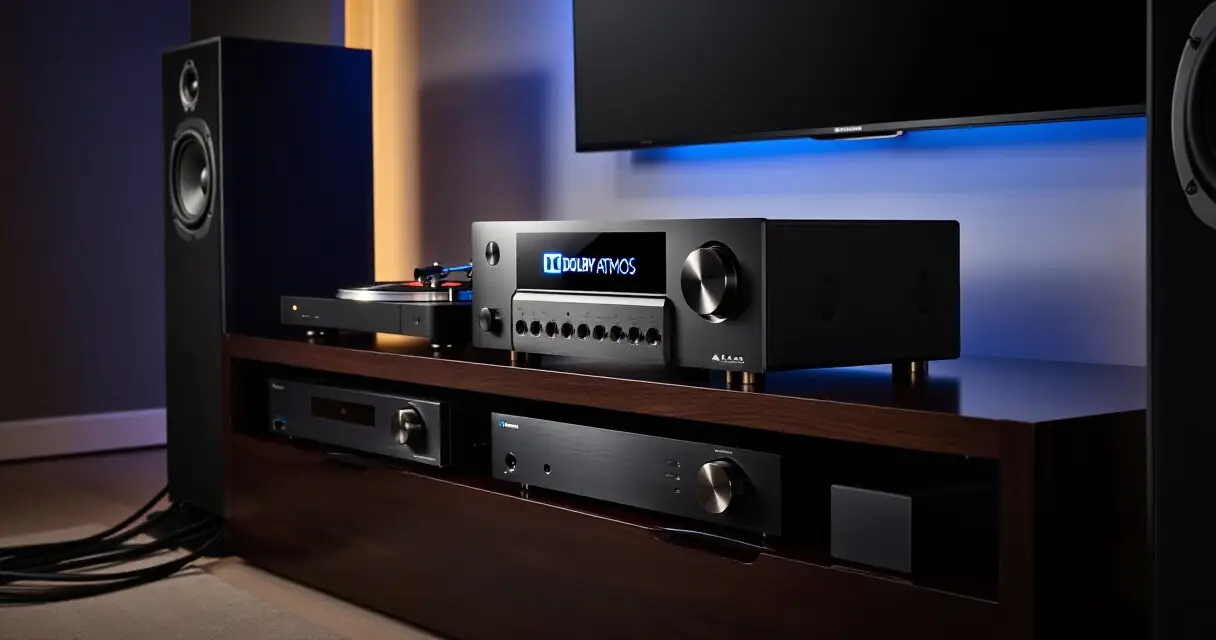
For readers who use an AV receiver as the hub for both a home theater system and a vinyl listening setup, the phono input situation is worth examining. Most AV receivers in the price ranges reviewed here include a phono input — the Denon AVR-X1800H, AVR-X3800H, and Sony STR-AN1000 all include a dedicated phono input per their specification sheets. The phono input applies the RIAA equalization curve needed to bring a moving-magnet cartridge signal to line level, so if your turntable has a built-in phono preamp already, use the LINE input setting on your turntable and connect to any analog RCA input on the receiver instead.
If you are pairing a high-quality turntable with a dedicated external phono stage — a common choice at the mid and upper levels of vinyl listening — connect the external phono stage’s output to any analog line-level input on the receiver. This bypasses the receiver’s built-in phono stage entirely, which is typically a sensible trade because a dedicated phono preamp in the $150–$500 range will outperform the receiver’s built-in circuit at that investment level. For more on building a complete vinyl listening chain, see our guides on best turntables for beginners and the best amplifier for turntable, which covers dedicated stereo integrated amplifiers as an alternative to AV receivers for pure music listening.
Related Reading
Building a complete home audio or home theater system involves decisions beyond the receiver itself. These guides cover the surrounding components:
- Best Turntable for Beginners: What to Buy in 2026 (and What to Avoid) — the complete guide to selecting a first turntable, including what to look for in motor type, cartridge, and platter bearing at each price point.
- Best Record Player with Speakers: All-in-One vs Separates (2026) — when a self-contained system makes sense versus building a receiver-based rig.
- Best Home Stereo System for Music: Three Routes and What They Cost — comparing the all-in-one, separates, and active-speaker approaches with real price examples.
- Best Amplifier for Turntable in 2026: The Complete US Buying Guide — stereo integrated amplifiers as an alternative to AV receivers for music-first setups.
- Best Turntable Under $500: What the Extra Money Buys (2026) — the spec-led guide to the $200–$500 turntable bracket and where the meaningful performance jumps occur.
Limitations of This Guide
This guide does not cover 2-channel stereo receivers or integrated amplifiers, which are the better choice for music-only listening setups. It also does not address network AVRs in the above-$5,000 professional tier (Anthem, Arcam, StormAudio, Trinnov). The specifications here come from manufacturer product pages, authorized US retailers (Adorama, Best Buy, Crutchfield, Newegg), and specialist review sites (frontdeskreview.com, itechguides.com, stereonexus.com, thetechsearch.com) as of September 2026 — prices and availability will change. We have not performed firsthand acoustic measurements or listening tests; all performance characterizations draw from the named third-party sources cited throughout. Power figures are presented as published by the manufacturer under the conditions stated; independent third-party lab measurements may differ.
Conclusion: The Right AV Receiver for 2026
The AV receiver market in 2026 rewards buyers who do the homework on HDMI port specifics, room correction system quality, and the realistic speaker layout they will build — not the aspirational one. For the majority of US buyers, the Denon AVR-X1800H at ~$849 is the correct starting point: it handles every current format, connects to three 4K/120 gaming sources simultaneously, and delivers Audyssey room correction with a well-supported streaming ecosystem. Buyers with more demanding acoustic environments or larger speaker layouts should step up to the Denon AVR-X3800H at $1,799 for full HDMI 2.1 across all inputs, XT32 room correction, and the nine-channel amplifier section needed for 7.1.4 without external power. The Onkyo TX-NR7100 remains the strongest value argument for Dirac Live at under $800. And the Marantz Cinema 30 stands alone for buyers wiring a dedicated room with eleven speaker positions.
Whatever you choose, the consistent advice from every current buying guide is the same: match the receiver to the speakers and room you actually have, not the one you might someday build. The $849 Denon driving a well-chosen 5.1.2 speaker set in a room measured by Audyssey will consistently outperform a $1,800 receiver running mis-matched speakers in an uncorrected room.